
Annual Report 2025-2026
Public Prosecution Service of Canada
If you would like to know more about the Public Prosecution Service of Canada (PPSC), please refer to our website and the following documents:
© His Majesty the King in Right of Canada, represented by the Attorney General of Canada, 2026.
This document is available in multiple formats upon request.
Images contained in this document have been modified using AI technologies.
- LinkedIn: Public Prosecution Service of Canada
- Facebook: Public Prosecution Service of Canada | Service des poursuites pénales du Canada
ISSN 1926-3791 (Online)
Letter of Transmittal
June 29, 2026
The Honourable Sean Fraser, P.C., M.P.
Minister of Justice and Attorney General of Canada
House of Commons
Ottawa, Ontario K1A 0A6
Dear Attorney General:
Pursuant to section 16(1) of the Director of Public Prosecutions Act, I am pleased to present you with the 2025-2026 Annual Report of the Public Prosecution Service of Canada. The report covers the period from April 1, 2025, through March 31, 2026.
Sincerely,
(original signed by)
George Dolhai
Director of Public Prosecutions and Deputy Attorney General of Canada
Land Acknowledgement
The PPSC acknowledges Canada as the land of the First Peoples (Nations), Métis and Inuit. We recognize that most of the land we use to live, work, and enjoy is shared in accordance with historic and contemporary treaties. Other land continues to be unceded territory.
Our commitment to truth and reconciliation is reflected in our core values. We acknowledge the historical and ongoing failure to protect the lives, values, and cultures of the Indigenous Peoples of Canada. We seek to reconcile the differing values of the Canadian criminal justice system with those of the Indigenous Peoples of Canada. Our aim is to build a just relationship that addresses both the overrepresentation of Indigenous Peoples within the criminal justice system and the high rates of violence against Indigenous Peoples, particularly Indigenous women, girls, and 2SLGBTQIA+ people.
We are committed to better understanding the truth of how colonialism affects Indigenous Peoples. How it unsettled the relationship between the first stewards and the land. How it directly disrupted the relationship between Indigenous Peoples, their culture, and their relationship with each other in their families and communities. How this brought tremendous disruption to their lives leading to significant and enduring, intergenerational trauma.
Our dutiful role in reconciliation is to ensure our prosecutorial work evolves. This means that we can and must intentionally contribute to reducing the mass incarceration of marginalized groups in the criminal justice system, particularly Indigenous Peoples.
Message from the Director of Public Prosecutions

I am proud to share this report, which highlights what colleagues across the Public Prosecution Service of Canada (PPSC) accomplished over the past year as we continued to respond to an increasingly complex prosecution environment. The work described throughout this Annual Report demonstrates not only what we achieved, but also how we are intentionally preparing the organization for the challenges that lie ahead.
As a national prosecution service grounded in the rule of law, fairness, professionalism, and public service, we provide Canadians with stability and confidence in the administration of justice, even as the legal, technological, and social environments in which we operate continue to evolve.
The challenges facing prosecutors today are increasingly complex. The PPSC has adapted to the marked escalation in the involvement of young persons in terrorism threat activities through the use of peace bonds to control their activities while prosecuting those who recruit and indoctrinate youth. In northern communities, women and children continue to experience unacceptable levels of violence, including sexual violence, requiring specialized expertise and sustained support throughout the criminal process.
We are also called upon to prosecute acts causing severe environmental damage with lasting impacts on communities and future generations, where scientific evidence, corporate decision-making, and complex evidentiary issues intersect. The PPSC is prepared to face each of these daunting elements.
The largest portion of the PPSC’s work continues to involve drug-related offences, particularly those linked to organized criminal networks that place profit above the health, safety, and lives of Canadians. Volumes of fentanyl, cocaine, synthetic opioids, and other dangerous substances that were once rare are at unprecedented levels.
Police must determine how to practically gather evidence in the face of criminal communications that are routinely encrypted and otherwise shielded. The PPSC plays a critical role by providing legal advice to investigative agencies, helping ensure that evidence is gathered lawfully, assessing whether the evidentiary standard for prosecution has been met, and presenting cases before the courts for independent determination. To identify the top levels of sophisticated criminal organizations requires many investigative steps, which are potentially subject to challenge during a prosecution. This work is made more challenging by rapidly evolving technologies and changing case law regarding privacy and digital communications. Investigative legal authorities, moreover, must often be interpreted and applied in circumstances that could not have been anticipated when many of the governing laws were originally enacted.
At the same time, prosecutions themselves are becoming more demanding. Investigations increasingly involve encrypted communications, large volumes of digital evidence, body-worn camera footage, surveillance recordings, forensic data, and complex disclosure obligations. Prosecutors and paralegals must assess and manage unprecedented quantities of information while ensuring that proceedings remain fair, efficient, and consistent with Canadian Charter of Rights and Freedoms protections. The trial process must deal with all defence applications unless they are manifestly frivolous. Pre-trial challenges can become forensic reviews of the nuts and bolts of sensitive aspects of new technologies without a demonstrable concern about the judge’s decision to authorize the police to proceed, or a concern about the reliability of the evidence obtained.
As the landscape is changing, we are intentionally evolving with it. Over the past year, much of our effort focused on laying the groundwork needed to ensure that the PPSC remains effective, agile, and principled in the years ahead. For example:
Setting up our people to have the right training and skills
Through the revitalization of the Federal Prosecutor Development Program, updates to law practice standards, and expanded legal and non-legal training opportunities, we are helping ensure that our people are equipped to meet the demands of an increasingly complex prosecution environment.
Procuring and setting up the right tools
We are modernizing our tools and processes through initiatives supporting digital evidence management, stronger information management practices, improved disclosure processes, and the responsible exploration of artificial intelligence.
Ensuring that our leaders reinforce the importance of values and character
Inclusive staffing practices, character-based leadership development, and timely principled guidance help ensure that our organizational culture remains firmly grounded in the values that define public prosecution.
Maintaining focus through clear organizational priorities
We have reviewed our organizational priorities to ensure that our collective efforts remain focused on enhancing prosecutorial effectiveness in an increasingly complex and evolving legal landscape.
These initiatives are not isolated projects. Together, they represent deliberate investments in the people, tools, leadership, and partnerships within and beyond the PPSC that will allow us to continue serving Canadians effectively in a rapidly changing environment.
Being a prosecution service is, above all, a people-focused responsibility. I am deeply grateful for the professionalism, judgment, dedication, and integrity demonstrated every day by employees across the organization. Whether supporting investigations, preparing cases, appearing before the courts, advancing modernization initiatives, or supporting colleagues, their contributions strengthen public confidence in Canada’s justice system.
Looking ahead, we will continue to be clear-eyed about emerging challenges, steadfast in our principles, thoughtful in our actions, and confident in our ability to adapt. The accomplishments highlighted throughout this report reflect an organization that is building strong foundations for the future while remaining firmly anchored in its mandate and values.
It is my hope that this report will provide Canadians with confidence in the administration of criminal justice and in the dedicated public servants who contribute to it every day.
(original signed by)
George Dolhai
Director of Public Prosecutions and Deputy Attorney General of Canada
Deputy Directors of Public Prosecutions
Carol Shirtliff-Hinds and Shannon O’Connor serve as the Deputy Directors of Public Prosecutions with the Public Prosecution Service of Canada. They provide strategic leadership, legal expertise, and executive oversight in advancing the organization’s mandate. Their areas of commitment are:
- the criminal justice system
- legal education
- equity, diversity, inclusion, and accessibility
- digital transformation

Carol Shirtliff-Hinds

Shannon O’Connor
At a Glance
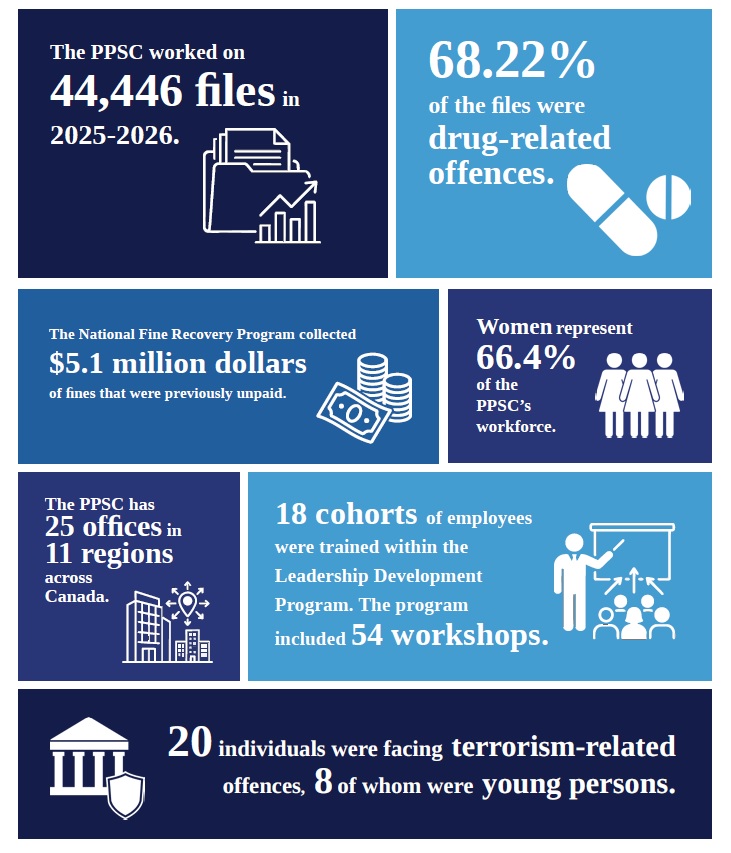
Text Version
This infographic includes 7 quadrants. The first quadrant, top left, has a navy blue background and includes the text "The PPSC worked on 44,446 files in 2025-2026." Below the text is an icon of papers coming out of a file folder and a bar chart that indicates an increase.
The second quadrant, top right, has a light blue background. It includes the text "68.22% of the files were drug-related offences." Below the text is an icon of pills.
The third quadrant, second row to the left, has a medium blue background. It includes the text "The National Fine Recovery Program collected $5.1 million dollars of fines that were previously unpaid." Below the text is an icon of money.
The fourth quadrant, second row on the right, has a dark blue background. It includes the text "Women represent 66.4% of the PPSC’s workforce." Next to the text is an icon representing women.
The fifth quadrant, third row on the left, has a dark blue background. It includes the text "The PPSC has 25 offices in 11 regions across Canada." Below the text, is an icon of office buildings and a location marker pointing in many directions.
The sixth quadrant, third row to the right, has a light blue background. It includes the text "18 cohorts of employees were trained within the Leadership Development Program. The program included 54 workshops." Next to the text, is an icon of an instructor presenting in front of a group of people.
The last quadrant, along the bottom, has a navy blue background. It includes the text "20 individuals were facing terrorism-related offences, 8 of whom were young persons." Next to the text, is an icon of a courthouse and a shield.
Table of Contents
- About the PPSC
- Organizational Snapshot
- How do we Serve Canadians?
- Drug Prosecutions in Canada
- Prosecutions with a Focus on the Security of the Canadian Society
- Protecting Canada’s Environment, Economy and Borders
- Prosecutions in Canada’s North
- In what Supreme Court of Canada Cases was the PPSC involved?
- How do we make sure new risks don’t undermine the quality or integrity of our prosecutions?
- How do we support the recovery of federal fines?
- Federal-Provincial-Territorial Heads of Prosecutions Committee
- Case Profiles
- Awards and Achievements
- Financial Information
- Contact Information
About the PPSC

What is the Public Prosecution Service of Canada?
The Public Prosecution Service of Canada (PPSC) is a national, independent, and accountable prosecuting authority. Our main objective is to prosecute cases under federal jurisdiction in a fair manner that is free from any improper influence. The Director of Public Prosecutions (DPP) is accountable to the Attorney General of Canada (AGC) and both the DPP and the AGC are required to perform their functions free of political influence or considerations. The PPSC is accountable to Parliament and has an obligation to the courts to present them with all available, relevant, and admissible evidence to preserve the fairness of the criminal justice system.
Mandate
The PPSC is a distinct governmental organization managed by the DPP. The DPP has the rank and status of a deputy head (deputy minister) of a department but does not report to the Clerk of the Privy Council as is the case with other deputy ministers. Mandated by the Director of Public Prosecutions Act, the DPP is the Deputy Attorney General of Canada responsible for prosecutions. The DPP is empowered to:
- initiate and conduct federal prosecutions;
- intervene in proceedings that raise a question of public interest that may affect the conduct of prosecutions or related investigations;
- issue guidelines to federal prosecutors;
- advise law enforcement agencies or investigative bodies on general matters relating to prosecutions and on particular investigations that may lead to prosecutions;
- communicate with the media and the public on all matters that involve the initiation and conduct of prosecutions;
- exercise the authority of the AGC in respect of private prosecutions; and
- exercise any other power or carry out any other duty or function assigned by the AGC that is compatible with the Office of the DPP.
Unlike in other departments and agencies, the AGC has no relationship with the employees of the PPSC as the authority of those fulfilling the mandate results from their delegation from the DPP.
The Director of Public Prosecution Act also empowers the DPP to:
- initiate and conduct prosecutions under the Canada Elections Act; and
- act, when requested by the AGC, in matters under the Extradition Act and the Mutual Legal Assistance in Criminal Matters Act.
With the exception of Canada Elections Act matters, the AGC can issue a directive to the DPP about a prosecution or assume conduct of a prosecution, but must do so in writing and a corresponding notice must be published in the Canada Gazette. In turn, the DPP must inform the AGC of any prosecution or planned intervention that may raise important questions of general interest.
The PPSC is also responsible for administering the recovery of outstanding federal fines under the terms of an assignment issued by the AGC in 2007.
Role of the Prosecutor
Prosecutors pursue justice, act in the public interest and serve as impartial representatives of justice. The only cases that should be brought to trial are those that have a reasonable prospect of conviction on the admissible evidence and that are in the public interest to prosecute. In exercising their duties, prosecutors must make decisions that are free from any personal, private or political considerations. They act above all suspicion, and exercise their discretion fairly, impartially, and in good faith. The importance of prosecutorial independence is so great that it is a constitutional principle.
Prosecutors contribute directly to the safety and security of Canadians. They play a key role in the Canadian criminal justice system by serving the truth-seeking function of criminal proceedings. The role of a prosecutor is not to seek convictions at any cost, but to put before the court all available, relevant, and admissible evidence, fairly, resolutely with all legal proofs pressed to their legitimate strength, in order to enable the court to determine the guilt or innocence of an accused, who is presumed innocent throughout the trial.
Prosecutors act separately and independently in advising investigative agencies and conducting prosecutions. Prosecutors, however, will advise the police and investigative agencies of how prosecutorial decisions are made in accordance with the law and constitutional principles. For example, they can discuss whether the evidence gathered would be admissible when prosecutors assess for a reasonable prospect of conviction and public interest.
Prosecutors must always protect the integrity of the criminal justice system. They strive to make it more equitable and fairer to all. They must be vigilant in challenging biases and stereotypes. Prosecutors proactively guard against wrongful convictions or miscarriages of justice, even after a prosecution is ended.
Prosecutors must conduct themselves in accordance with the highest ethical standards. They are subject to rules of professional conduct and ethics. They are accountable to the courts and the DPP.
Prosecutorial Independence
The duties and responsibilities of the DPP are unique in the practice of law. By virtue of a statutory delegation enacted in 2006, the DPP carries out the prosecution function that is conferred by Parliament on Canada’s Attorney General. In doing so, the DPP executes a quasi-judicial role under an umbrella of prosecutorial independence. That independence, which is the foundation for the DPP’s exercise of authority, is a constitutional principle. It ensures that the DPP’s decision-making is protected from improper consideration and influence which, in turn, protects and preserves the public interest in the rule of law and principled prosecutions based on the evidence. Prosecutors are not lawyers for the police, the victims, or the accused. The prosecutor’s undivided loyalty is to the proper administration of justice.
The independence of the prosecution function is a fundamental component of our democracy and the freedoms we all enjoy. The Supreme Court of Canada has determined that a prosecutor’s duty "to respect his or her ’Minister of Justice’ obligations of objectivity and independence" is a principle of fundamental justice under s. 7 of the Canadian Charter of Rights and Freedoms. It is an "essential protection of the citizen against the sometimes overzealous or misdirected exercise of state power" and is "one of the more important checks and balances of our criminal justice system" (R. v. Regan, 2002 SCC 12, at para. 157; R. v. Cawthorne, 2016 SCC 32, at para. 23).
Prosecutorial independence must be protected and preserved. This responsibility is held by the DPP and shared by all prosecutors and agents acting on behalf of the Crown. As a constitutional imperative, prosecutorial independence contains an implied limitation that the independence of the DPP cannot be undermined. The DPP is therefore duty-bound to ensure the preservation of our constitutional structure and the relationships between the courts and Parliament, which includes the independence of the prosecution function. The DPP will continue to take appropriate steps to protect and preserve the integrity of the prosecutor’s independence.
Our Mission
Our mission is to serve the public interest and help make Canada a safe and just society by:
- conducting prosecutions in a manner that is equitable, objective and independent, while protecting the rights of every individual; and
- contributing to the change necessary to support a criminal justice system that is fair to all.
Our Values
Our values serve as a guide for expected behaviour and action for all employees at the PPSC. These values are also advanced through institutional leadership and expertise, including the work of the PPSC’s Advancement Centre for Equity, Diversity, and Inclusion.
The values also outline what Canadians should expect from us, and what we should expect from each other.
Finally, every PPSC employee has a role to play in creating a work environment where every person can bring their whole self to work and feel valued and empowered to contribute.
Respect
We are committed to treating everyone equitably, with empathy, and compassion because everyone is worthy of respect.
Trust
We work to earn the trust of our colleagues and the communities we serve. We are accountable for what we say and do.
Professionalism
We use our knowledge, skills, experience, and judgment to be effective. Our humility, integrity, and wisdom are apparent in our work. We function as one team to leverage everyone’s strengths and remain flexible to adapt to change. We continuously strive to learn and seek better ways of doing our work.
Courage
We make difficult decisions informed by fairness and justice. We confront biases including our own. We stand up against injustice, harassment, and discrimination.
Equity and Inclusion
We want to contribute to a criminal justice system that truly serves the public interest. We acknowledge our past failures and are determined to eliminate systemic discrimination and the overrepresentation of Indigenous, First Nation, Métis, Inuit, Black, racialized, and marginalized persons in the criminal justice system. We seek to be equitable, accessible, accommodating, and inclusive by design. We are strengthened by people of diverse heritages, faiths, cultures, abilities, and cognitive functioning.
Commitment to Truth and Reconciliation
We acknowledge the historical and ongoing failure to protect the lives, values, and culture of the Indigenous Peoples of Canada. We seek to reconcile the differing values of the Canadian criminal justice system with those of the Indigenous Peoples of Canada. Our aim is to build a just relationship that addresses both the overrepresentation of Indigenous Peoples within the criminal justice system and the high rates of violence against Indigenous Peoples, particularly Indigenous women and girls.
Our Priorities
Our mandate relates to one type of activity: fair, independent and impartial prosecutions of federal offences within the jurisdiction of the Attorney General of Canada. Each organizational priority is an integral part of achieving the greater goal.
Our priorities for the 2025-2026 fiscal year were:
- Take action against systemic discrimination and racism in the criminal justice system;
- Advance equity, diversity, and inclusion in the workplace;
- Foster a culture of trust and engagement; and
- Modernize the way we work.
Over the past year, we were also reviewing our priorities. This is an exercise we conduct every two years to make sure we are focusing our collective effort where it matters most. An updated set of priorities were developed with colleagues from across the organization to ensure that they are meaningful and resonate with every employee of the PPSC.
Our updated set of priorities for 2026 until 2028 are:
- Enhancing prosecutorial effectiveness in a complex and evolving legal landscape;
- Building a resilient, inclusive workplace grounded in trust, engagement, anti-racism, and reconciliation with Indigenous Peoples;
- Taking action against systemic discrimination and racism in the criminal justice system; and
- Modernizing the way we work.
Organizational Snapshot

Structure
Our organizational structure, headed by the DPP and supported by corporate services and regional offices, is shown below:
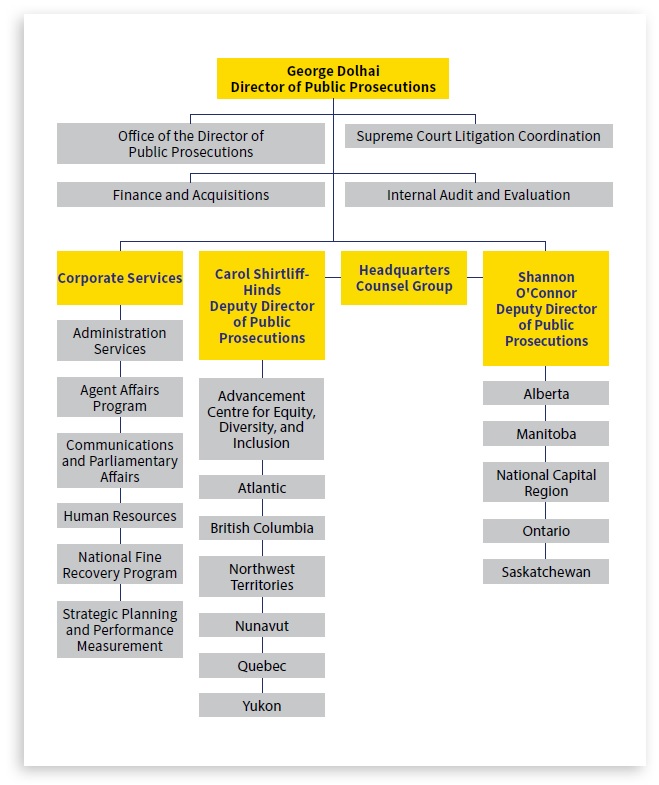
Text Version
- George Dolhai - Director of Public Prosecutions
- Office of the Director of Public Prosecutions
- Finance and Acquisitions
- Supreme Court Litigation Coordination
- Internal Audit and Evaluation
- Corporate Services
- Administration Services
- Agent Affairs Program
- Communications and Parliamentary Affairs
- Human Resources
- National Fine Recovery Program
- Strategic Planning and Performance Measurement
- Carol Shirtliff-Hinds - Deputy Director of Public Prosecutions
- Advancement Centre for Equity, Diversity, and Inclusion
- Atlantic
- British Columbia
- Northwest Territories
- Nunavut
- Québec
- Yukon
- Headquarters Counsel Group
- Shannon O’Connor - Deputy Director of Public Prosecutions
- Alberta
- Manitoba
- National Capital
- Ontario
- Saskatchewan
Governance and Leadership
The PPSC is led by the DPP, who holds the rank and status of a deputy head. The DPP is supported by two Deputy Directors of Public Prosecutions (DDPP), who provide strategic leadership, legal expertise, and executive oversight.
Each region is led by a Chief Federal Prosecutor and at least one Deputy Chief Federal Prosecutor. Together, they oversee prosecutions in their assigned geographic area, manage and supervise their offices, provide guidance on complex or sensitive cases, engage with community partners, and participate in national decision-making forums.
The PPSC’s daily operations are supported by its corporate services functions, which provide essential expertise to the organization. Executives within the corporate services divisions also participate in national decision-making forums, supporting effective governance and strategic decision-making.
Offices
We have 25 offices across Canada, divided into 11 regions, each focusing on local needs and priorities. Our regional offices provide advice and training to the law enforcement agencies in their regions.
We handle a broad range of federal prosecutions, including federal offences relating to drugs, regulatory and economic offences, and national security offences. In the territories, we prosecute Criminal Code offences, as well as offences under all federal statutes.
In many provinces and territories, our prosecutors travel to smaller communities throughout the year to provide their services for circuit court. We also retain the services of 76 law firms with 385 staff members (lawyers, paralegals, and support staff) approved to assist with prosecutions on behalf of the Federal Crown where it is impractical or otherwise not cost-effective for our prosecutors to handle prosecutions.
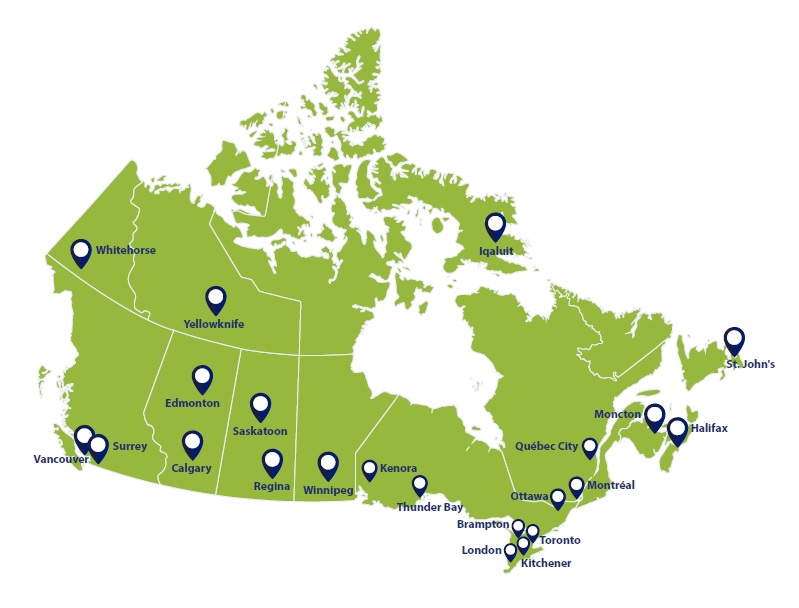
Text Version
A green map of Canada with navy blue markers indicating the following locations of PPSC offices:
- Whitehorse
- Vancouver
- Surrey
- Yellowknife
- Edmonton
- Calgary
- Saskatoon
- Regina
- Winnipeg
- Kenora
- Thunder Bay
- Iqaluit
- Brampton
- London
- Kitchener
- Toronto
- Ottawa
- Montréal
- Québec City
- Moncton
- Halifax
- St. John’s
Our People
We could not fulfill our mandate without the ongoing commitment of the 1,110 people employed across the country who are working to advance our priorities.
| Regions | Number of Employees |
|---|---|
| Alberta | 111 |
| Atlantic | 62 |
| British Columbia | 113 |
| Manitoba | 49 |
| National Capital Region | 89 |
| Northwest Territories | 53 |
| Nunavut | 33 |
| Ontario | 193 |
| Quebec | 75 |
| Saskatchewan | 30 |
| Yukon | 37 |
| Headquarters in Ottawa | 265 |
| Total | 1,110Footnote 1 |
| |
| First Official Language | PPSC Employees |
|---|---|
| English | 852 |
| French | 258 |
| Total | 1,110 |
| Employment Equity | Racialized Groups | Indigenous People | Persons Living with a Disability | Women |
|---|---|---|---|---|
| PPSC RepresentationFootnote 2 | 22.5% | 6.1% | 9.2% | 66.4% |
| PPSC Workforce Availability EstimatesFootnote 3 | 20.9% | 5.5% | 12.0% | 62.0% |
| Public Service RepresentationFootnote 4 | 23.9% | 5.5% | 9.0% | 56.8% |
| ||||
| Employment Equity | Racialized Groups | Indigenous People | Persons Living with a Disability | Women |
|---|---|---|---|---|
| PPSC RepresentationFootnote 2 | 16.2% | - | - | 64.9% |
| PPSC Workforce Availability EstimatesFootnote 3 | 12.0% | 6.0% | 5.3% | 39.1% |
| Public Service RepresentationFootnote 6 | 17.3% | 5.6% | 10.9% | 55.9% |
| ||||
To ensure all employees are welcomed, accepted, and supported, we worked on a number of initiatives.
Supporting a Modern and Inclusive Workplace
We provide PPSC employees across Canada with the tools, the services, and the safe workplaces they need to deliver high-quality public service.
This year, we advanced responsible innovation by introducing a secure artificial intelligence (AI) tool across the organization. Employees were given access to practical training and clear policy guidance that helped them use AI ethically to draft documents more quickly, summarize information, and simplify routine tasks so they can focus on more complex work.
We continued our work to strengthen the PPSC’s culture of service excellence through responsive and transparent support. This included timely IT assistance, practical help with records management, and solutions for day-to-day workplace needs.
Upgrades to our security program, to our threat-management processes and to our physical offices—such as refreshed workspaces and ergonomic and accessibility improvements—further contributed to employee well-being and safety.
Accessibility remains a priority. Over the past year, we have enhanced collaboration and introduced a new organizational structure to better support employees and improve services. This approach will help us more effectively track trends and deliver consistent, timely, and meaningful support to current and future employees who want to make a difference in the justice system.
Workplace Well-being
We are committed to keeping our employees safe, healthy, and supported, both at work and when they are carrying out official duties outside the office. This year, we focused on creating safer and more supportive environments by:
- offering training to help employees recognize and manage stress, including vicarious trauma awareness and mental health first aid;
- providing managers with training on the tools and services available to support both their own well-being and that of their teams;
- responding to urgent or specific needs by working directly with individual teams and offices to provide targeted training and resources;
- promoting mental health and wellness supports, such as LifeSpeak, and recognizing key wellness days through internal articles and email communications; and
- partnering with a fitness company to support physical health and overall employee’s well-being.
In addition, our ongoing contract with Health Canada provides employees with access to the following services:
- Employee Assistance Program: Emergency counselling with connection to outside professionals as needed
- Healthy Workplace Services: Provides a safe space to talk about workplace concerns and explore options, without the fear of reprisal
- Informal Conflict Management: Helps prevent, manage, and resolve workplace issues
In 2025-2026, the PPSC also signed a memorandum of understanding with Innovation, Science and Economic Development Canada, partnering the PPSC with other agencies to support the Canadian Innovation Centre for Mental Health in the Workplace, which provides webinars on a variety of mental health and wellness topics, including, but not limited to:
- Black Mental Health
- Coping with change
- Leadership
- Resiliency
Commitment to Official Languages
Recognizing that Indigenous languages, French and English are the historical foundations of Canada’s linguistic diversity, we continued to implement our Official Languages Action Plan. We remain committed to demonstrating leadership, innovation and creativity in meeting our official languages obligations and to actively contributing to initiatives that support strengthening the use of Indigenous languages.
Equity, Diversity, and Inclusion
After the completion of our 2021–2024 Equity, Diversity, Inclusion and Accessibility Action Plan, we reviewed our progress, gaps, and organizational equity, diversity and inclusion maturity.
This work is aligned with guidance from the Treasury Board Secretariat’s Maturity Model on Diversity and Inclusion. Using this model, we repositioned equity, diversity, and inclusion as a core strategic capability. This approach strengthens prosecutorial excellence, builds employee trust, and contributes to reducing systemic inequities in Canada’s criminal justice system. Rather than relying on time limited action plans, we are taking a long-term approach focused on continuous improvement, clear accountability, and lasting culture change.
Supporting Linguistic Minority Communities Across Canada
Our ongoing commitment is reflected in the positive measures we take to support the vitality of French and English linguistic minority communities across the country and to ensure that everyone can access justice in the official language of their choice. These measures include delivering presentations in official language minority high schools to spark students’ interest in law and support their career aspirations. It also includes our support to the Association des juristes d’expression française [Association of Francophone jurists], who play a key role in promoting access to justice in French.
Key Results:
- We advanced the integration of an equity, diversity, and inclusive lens into prosecutorial decision-making and legislative modernization by applying Indigenous-led legal principles in the Supreme Court of Canada’s His Majesty the King v. Cope appeal and by informing Parliament’s review of the Fisheries Act.
- The Advancement Centre for Equity, Diversity, and Inclusion strengthened its role as a centre of expertise by ensuring that equity, diversity, and inclusion considerations are integrated by design into corporate initiatives and emerging policy areas.
- We created an Indigenous Justice Portfolio. This portfolio, led by a Senior Counsel at the Headquarters Counsel Group, is responsible for litigation support and strategy; liaison and partnership; community engagement and Indigenous employee support and mentorship.
- Through national events on race, culture, and justice, including sessions with Dr. Rachel Zellars, Chief Justice Michael Tulloch, and Chief Judge Perry Borden, we increased organizational understanding of systemic inequities affecting communities of people that come into contact with the criminal justice system. In addition, coaching and support provided to Black and racialized employees further contributed to safer, more informed, and more trauma-aware workplaces within the organization.
- The National Councils for Employees and the Regional Equity, Diversity, Inclusion and Accessibility Committees remained as essential groups for employee voices and contributed to actions on systemic discrimination and organizational improvements.
Leadership Development and its Changing Demographic
Last year, we continued to invest in our leaders to ensure they have the skills and competencies to achieve our mandate and to support our day-to-day work.
We delivered three interactive workshops focused on practical leadership skills, including active listening, conflict resolution and having difficult conversations. Participants used real life scenarios and role playing to build confidence. The Leadership Development Program was open to all PPSC supervisors. Last year, the program was delivered to 18 groups, with a total of 54 workshops offered.
Our recent staffing efforts show progress toward building a leadership team that better reflects the people we serve. As more employees with diverse lived experiences advance into leadership roles, decisions across the organization benefit from a wider range of perspectives. Over time, this leads to a steady and lasting change in the makeup of the PPSC’s leadership.
Character Leadership
We have continued to integrate character leadership in the selection processes for executives and have expanded it to Senior General Counsel positions. In 2025–2026, five Executives and six Senior General Counsels were appointed after successfully completing character leadership interviews. This involved an evaluation of eleven dimensions of characterFootnote 1, alongside competence, during the selection process. Character leadership also guides the ongoing development of leadership within the organization.
Federal Prosecutor Competency Standard
Over the past year, we updated the Federal Prosecutor Competency Standard for all prosecutors, from the articling student level to senior general counsel level. As a result of extensive consultation, the updated Standard is a modern, comprehensive and inclusive tool that can be used for developing, hiring and promoting prosecutors whose competencies reflect PPSC’s organizational priorities and values. The competencies established for the PPSC are in addition to the standards established by the law societies. Prosecutors must comply with the competency standards required by their respective law society to maintain their professional designation.
PPSC Supervisors’ Network
The Supervisors’ Network is a community of practice that brings together and empowers PPSC supervisors to engage with their peers, colleagues, and other leaders to facilitate knowledge and experience sharing.
The Network organizes activities that allow all the PPSC supervisors an opportunity to grow, learn new skills and competencies, and build relationships with their colleagues across the country.
How do we Serve Canadians?

In 2025–2026, we worked on 44,446 files. This includes 23,775 files opened during the year, as well as 20,671 files carried over from previous years. Overall, our prosecutors, paralegals, legal support staff, and legal agents working on behalf of the PPSC spent a total of 1,080,384 hours working on prosecution files during the year. Our prosecutors and paralegals also provided legal advice to investigative agencies, participated in various committees, both national and regional, and assisted with other important corporate work, as well as delivered or received training.
An important part of our role in the criminal justice system is to keep Canadians safe through the prosecution of:
- cases related to drug trafficking, possession, manufacturing, and importation with a focus upon the activities of criminal organizations;
- cases with a focus on the security of Canadian society;
- violations of federal statutes and regulations that protect the environment, safety, health, economic security, and general welfare of the Canadian public, including matters involving regulatory and economic crime; and
- violent crime offences and sexual violence offences in the three territories.
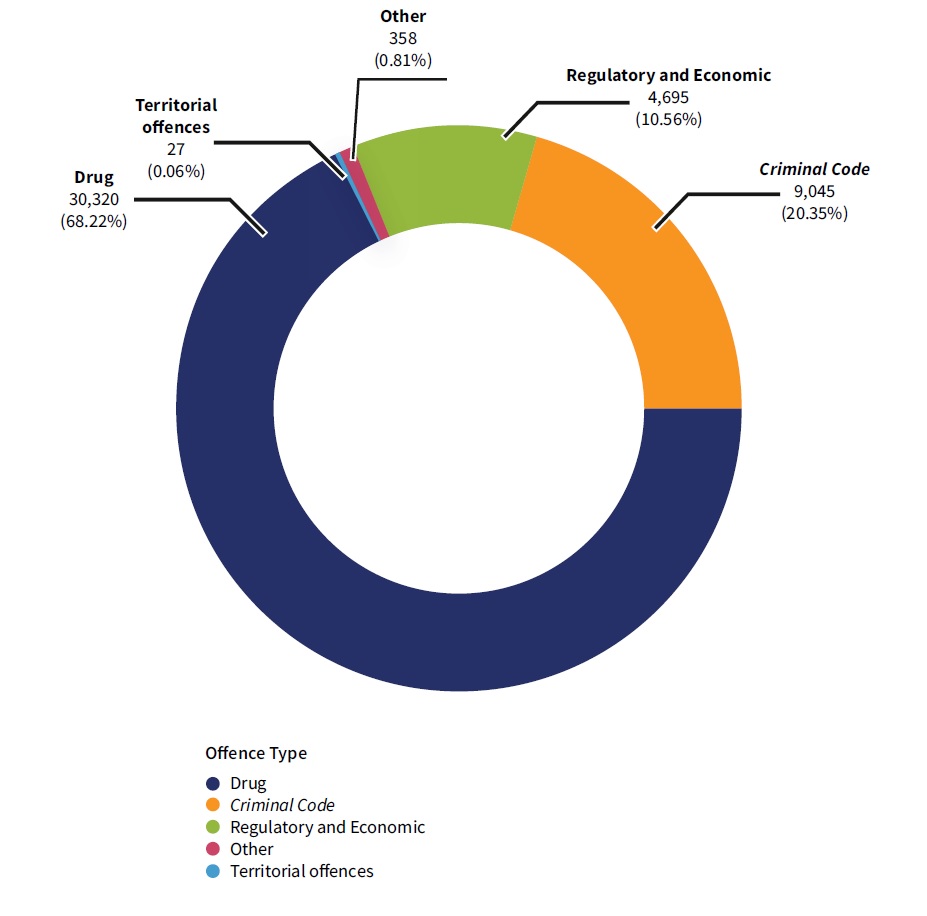
Text Version
| Offences | Number | % |
|---|---|---|
| Drug | 30,320 | 68.22% |
| Criminal Code | 9,045 | 20.35% |
| Regulatory and Economic | 4,695 | 10.56% |
| Other | 358 | 0.81% |
| Territorial offences | 27 | 0.06% |
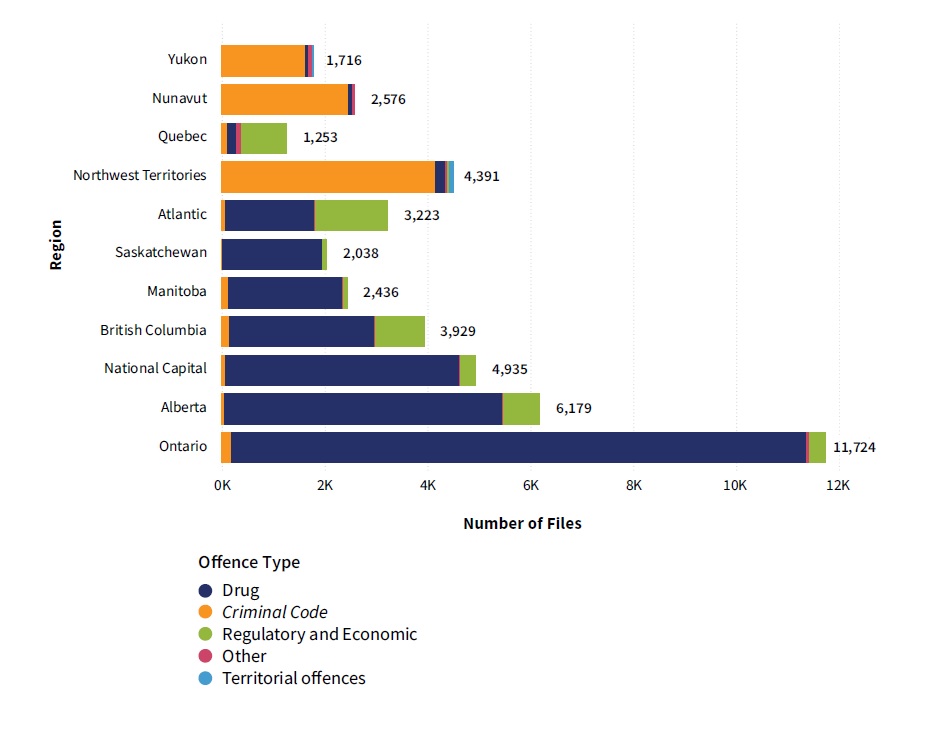
Text Version
| Region | Total | Drug | Criminal Code | Regulatory and Economic | Other | Territorial offences |
|---|---|---|---|---|---|---|
| Yukon | 1,716 | 63 | 1,623 | 0 | 22 | 8 |
| Nunavut | 2,576 | 65 | 2,469 | 0 | 42 | 0 |
| Quebec | 1,253 | 166 | 116 | 870 | 101 | 0 |
| Northwest Territories | 4,391 | 198 | 4,149 | 10 | 14 | 20 |
| Atlantic | 3,223 | 1,722 | 77 | 1,406 | 18 | 0 |
| Saskatchewan | 2,038 | 1,933 | 16 | 76 | 13 | 0 |
| Manitoba | 2,436 | 2,201 | 134 | 74 | 27 | 0 |
| British Columbia | 3,929 | 2,811 | 150 | 948 | 20 | 0 |
| National Capital | 4,935 | 4,557 | 62 | 289 | 27 | 0 |
| Alberta | 6,179 | 5,406 | 49 | 709 | 15 | 0 |
| Ontario | 11,724 | 11,185 | 179 | 311 | 49 | 0 |
Drug Prosecutions in Canada
"The PPSC recognizes the importance of health-based, rehabilitative approaches for individuals struggling with substance-use disorders, including those involving fentanyl. At the same time, it has a responsibility to seek meaningful accountability from those convicted of knowingly profiting from the suffering of others by contributing to the spread of harmful and potentially deadly substances."
– George Dolhai, Director of Public Prosecutions, June 11, 2025
We are responsible for the prosecution of offences under the Controlled Drugs and Substances Act (CDSA) across Canada. However, in Quebec and New Brunswick, we only prosecute CDSA offences when the Royal Canadian Mounted Police (RCMP) are the investigating agency. Drug prosecutions represent the largest share of our work. As the country continues to confront a national opioid overdose crisis—driven by the trafficking of fentanyl and other synthetic opioids distributed by organized crime networks—our prosecutors work tirelessly to ensure all related criminal charges are brought to a fair and just conclusion before the courts. We also provide critical legal advice to law enforcement agencies involved in the disruption of Canada’s illicit drug supply.
Outcomes of Drug Prosecutions
Excluding files that do not proceed (as explained below), the chart on p. 25 illustrates the outcomes of completed prosecutions over the past five years involving charges related to trafficking, production, importation, and exportation of drugs. In cases where charges are stayed or withdrawn, this is most commonly due to one or more of the following factors: (i) evidence is excluded by the court following a finding that the investigation contravened a right entrenched in the Charter; (ii) evidence becomes unavailable or less compelling as the case progresses, such that there is no longer a reasonable prospect of conviction; and/or (iii) the prosecution cannot be completed within the reasonable time established by the Supreme Court of Canada in the case of R. v. Jordan.
In drug cases, guilty pleas may occur at the end of a trial, but they frequently follow unsuccessful attempts by the defence lawyers to exclude evidence. Pre-trial hearings often address issues such as alleged Charter breaches, the admissibility of evidence under section 24(2) of the Charter, the validity of judicial authorizations (including search warrants and wiretap orders), or the constitutionality of legislation. Preparing and litigating these issues can be as complex and time-consuming as the trial itself.
The Evolving Illicit Drug Landscape
The persistent presence of fentanyl, its analogues and other synthetic opioids pose a profound risk to public safety. Offenders who profit from the commercial sale of these substances must face meaningful consequences for the substantial harm they impose upon our communities. In addition to addressing trafficking, preventing the domestic production and export of these substances remains essential. We assist law enforcement in achieving these objectives by offering timely and practical guidance on the lawful use of investigative techniques.
While fentanyl poses an acute threat, prosecutions involving other substances—including cocaine, methamphetamine, heroin and other synthetic drugs—are also treated as priority work. Seizures that once would have been considered extraordinary are now increasingly common, including multi-kilogram quantities of fentanyl, shipments of cocaine exceeding 100 kg, and thousands of pills of methamphetamine. Fentanyl production facilities, in particular, raise unique investigative and prosecutorial challenges.
Prosecutions are Becoming Increasingly Complex
Law enforcement initiatives targeting guns and gangs have led to a substantial increase in the PPSC’s workload. The investigation of offences related to these and other organized crime activities takes a lot of time and requires a lot of resources before charges are laid. The result is often that many accused are arrested and charged with numerous offences related to drug trafficking and firearms, both of which are closely intertwined with gang activities. In addition, large volumes of materials are produced requiring time to organize and review within tight deadlines to ensure trials are reached within a reasonable period of time. Prosecutors and paralegals must process extensive body-worn camera footage, surveillance recordings, digital communications, and forensic evidence, all of which demand significant time and resources to assess and disclose properly. In all aspects, prosecutions are bigger and have become more complex, which is increasing pressures on our prosecutors to work quickly and efficiently.
Targeting Illicit Drug Markets and Organized Crime
The opioid overdose crisis is a global tragedy that requires coordinated action among domestic and international partners. Dismantling criminal organizations involved in the production, import and export, and distribution of fentanyl and other dangerous controlled substances is essential to protecting public safety in Canada. We support this work by advising law enforcement on investigative strategies and by defending the legality of those techniques to secure the admissibility of the evidence obtained by them.
Our prosecutors advise police in major drug investigations, including efforts to identify and dismantle clandestine laboratories producing deadly substances and to prevent cross-border smuggling of drugs and precursor chemicals. Once arrests are made, prosecutors are under constant pressure to advance cases efficiently and expeditiously while addressing increasingly complex evidentiary issues.
Courts across Canada have consistently treated commercial fentanyl trafficking as an extremely serious offence, warranting lengthy custodial sentences to emphasize the need for both deterrence and denunciation within Canadian society. Sentencing ranges have been established throughout the country for periods of incarceration applicable to individuals involved in mid- and high-level drug trafficking operations. These ranges reflect the significant harm caused by the illicit distribution of fentanyl in our communities, which has contributed to a tragic number of accidental overdose deaths.
The PPSC continues to ensure that all relevant evidence is placed before the courts to fully convey the dangers fentanyl poses to Canadians. It has also taken steps to successfully appeal sentencing decisions where they are manifestly unfit. While sentencing remains an individualized process, courts addressing offences involving fentanyl trafficking must also give effect to the Supreme Court of Canada’s warning in the seminal case of R. v. Parranto, in which the Court observed: "Put simply, it is a crime that can be expected to not only destroy lives, but to undermine the very foundations of our society."
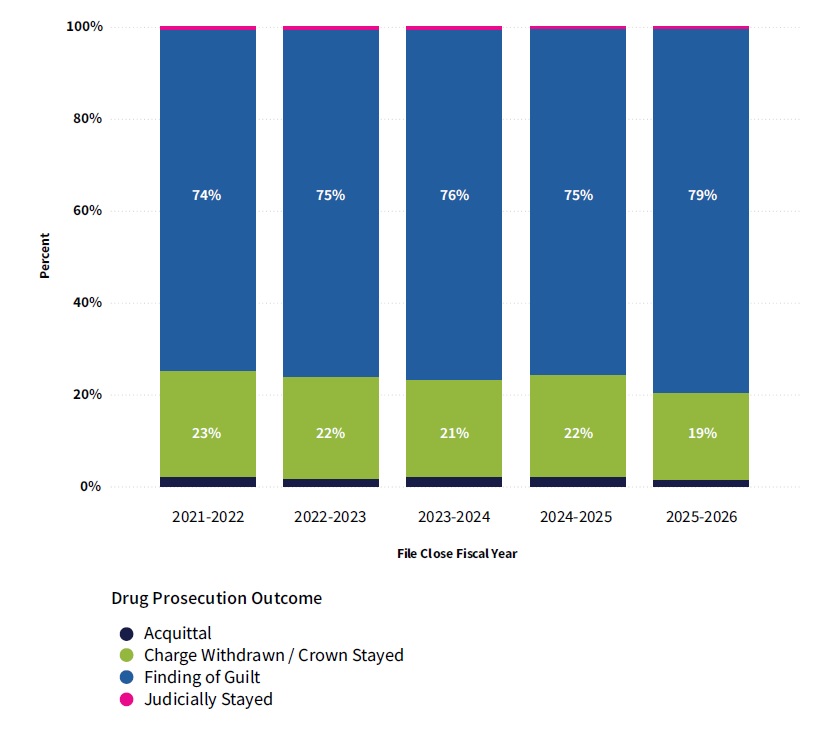
Text Version
| Fiscal Year | Acquittal | Charge Withdrawn / Crown Stayed | Finding of Guilt | Judicially Stayed |
|---|---|---|---|---|
| 2021-2022 | 2% | 23% | 74% | 0.5% |
| 2022-2023 | 2% | 22% | 75% | 0.5% |
| 2023-2024 | 2% | 21% | 76% | 0.5% |
| 2024-2025 | 2% | 22% | 75% | 0.5% |
| 2025-2026 | 2% | 19% | 79% | 0.25% |
Adapting to Technology and Digital Evidence
As criminal organizations adopt more sophisticated technologies to evade detection and increase profits, law enforcement must likewise rely on advanced tools—used lawfully—to investigate crime. Our prosecutors play a critical role by learning about these tools, advising investigators, and explaining their use to the courts. We are deliberately integrating new technologies into our work to enhance efficiency and keep pace with how they are being integrated into the daily life of all Canadians. However, we remain acutely aware that many of these same technologies are exploited by bad actors to conceal criminal activity, manipulate information, or accelerate harm. Our approach is therefore both forward looking and cautious: we seek to responsibly leverage the benefits that innovation offers, while maintaining rigorous oversight, transparency, and accountability to ensure that new tools are used lawfully, proportionately, and in a manner that preserves public confidence in the justice system. We remain firmly anchored to the highest ethical and professional standards.
"Canada is experiencing a wave of digital evidence as a result of the adoption of body-worn cameras by the police services that is characterized by the speed and the volume of data. We are exploring ways artificial intelligence (AI) can help manage this new reality more effectively and understand not only what AI can do but also what it won’t do. Clear boundaries help everyone use AI with confidence, protect our information, and ensure that legal and operational decisions remain firmly in human hands."
– Carol Shirtliff-Hinds, Deputy Director of Public Prosecutions
Taking the Profit out of Drug Crime: Proceeds of Crime
Illicit drug trafficking, production and importation are fundamentally profit-driven activities. Depriving the individuals who commit these offences of those profits is a key pillar of society’s response to these crimes. To that end, we are renewing our efforts to ensure that the identification and forfeiture of the proceeds of crime are considered in all of the prosecutions we conduct.
For drug offences, this means that, in addition to the sophisticated proceeds of crime and money laundering investigations and prosecutions required to dismantle major criminal enterprises, we are renewing our focus on forfeiture more broadly. This includes pursuing the proceeds generated by routine drug trafficking offences.
In addition, the DPP has reached out to his counterparts in the RCMP, Canada Border Services Agency and the Canada Revenue Agency to coordinate our efforts both in terms of cooperation in the pursuit of proceeds under the Criminal Code as part of a prosecution but also using alternative means of disruption such as civil forfeiture and the use of mechanisms under other federal legislation.
Prosecutorial Discretion and a Public Health-Informed Approach
The PPSC has always and continues to prosecute drug possession offences under subsection 4(1) of the Controlled Drugs and Substances Act (CDSA) throughout the country. Against this backdrop, it is important to note that when police lay charges for drug offences or other federal crimes, our first responsibility is to assess whether the charges meet the legal threshold to proceed. In 2020, we implemented a policy (PPSC Deskbook Guideline 5.13), which addresses cases involving possession of a controlled substance for personal use. This policy recognizes that substance use is also a health issue and that an alternative to criminal sanctions, as a first response, may be most effective in circumstances where there is no adverse risk to public safety. This principle was later codified in the CDSA in 2022. The result is not a prohibition on prosecution, but rather a measured approach that ensures police, Crown, and court resources are reserved for cases that pose a genuine threat to public safety. At the same time, it encourages alternative responses that prioritize treatment, helping individuals whose offences are driven by substance use to break the cycle of recidivism. Our policy is designed to keep communities safe while supporting individuals in meaningfully addressing problematic substance use and reintegrating into society as productive members.
Alternatives to Prosecution Team in British Columbia
Since 2023, the Alternatives to Prosecution Team in the British Columbia region has reviewed over 400 prosecution files to assess if they were appropriate to divert out of the criminal justice system. Diversion in appropriate cases improves justice system effectiveness and efficiency, produces better public safety outcomes, and delivers substantially better outcomes for victims. This work creates meaningful systemic change, advances reconciliation, and aims to treat underlying substance-use disorders as health issues and not criminal issues. As part of this portfolio, over 100 accused persons have successfully completed an alternative measure program, restorative justice process, or Indigenous-justice process, resulting in the withdrawal of charges. The British Columbia region has referred all types of files, including investigations involving police agencies, Department of Fisheries and Oceans, Service Canada, Environment and Climate Change Canada, and Canada Border Services Agency. As part of these processes, accused persons have participated in restorative circles, prepared letters of apology, reconnected with family members, regained custody of their children, engaged in acts of service with their communities, secured employment, attended counselling and treatment programs, obtained education, provided training sessions to investigators and community, and have made amends for the harm their actions caused.
Using alternatives to prosecution offers a powerful avenue for prosecutors to exercise their discretion appropriately and effect transformation of the system in a manner that is practical, effective, and compassionate.
Reducing Stigmatization and Diverting Where Appropriate
Stigma surrounding substance use remains a significant barrier preventing individuals from seeking help and accessing health and social services. We have taken deliberate steps to change how substance use is discussed within our offices and in courtrooms, raising awareness of the harmful effects of stigmatizing language and attitudes.
We regularly review our prosecution policies and guidelines to address systemic discrimination and to empower prosecutors to discontinue cases more appropriately treated as public health matters rather than criminal conduct. Where prosecution is necessary, prosecutors are encouraged to consider diversion to health and social services to help individuals avoid further involvement in the criminal justice system. These efforts support fairer outcomes while helping to reduce unnecessary criminal justice involvement.
Drug Treatment Courts: Integrated Responses to Substance Use
Drug Treatment Court (DTC) is a judicially supervised treatment program that enables persons suffering from substance-use disorder to meaningfully address their substance use. DTCs strengthen public safety by reducing recidivism among individuals with substance-use disorders. Our prosecutors support DTCs across Canada as part of multidisciplinary teams that include judges, defence counsel, police, and treatment providers. Together, these teams work toward a shared goal: breaking the cycle of reoffending.
The number of DTCs continues to grow nationwide, with new courts recently established in Ontario, Saskatchewan, and Newfoundland. Our prosecutors contribute to the creation of new DTCs, the design or re-design of their programs, and their ongoing operations.
In 2024, we updated our policies to provide greater flexibility in DTC programming, allowing court and treatment teams to tailor their approaches to regional needs and available resources. We also broadened eligibility criteria, making DTCs more accessible to individuals charged with criminal offences where there is underlying problematic substance use.
Participation in a DTC requires the accused person’s consent and may be considered at any stage of the prosecution, when appropriate. DTC teams have the flexibility to move away from rigid abstinence-based graduation requirements, recognizing that abstinence may not be a realistic or attainable goal for everyone living with a substance-use disorder.
A Prosecutor’s View: Addressing Bias in Prosecutorial Decision-Making
By: Crown Counsel, Toronto
Work still needs to be done, but many prosecutors are increasingly developing and applying skills to mitigate bias in their practice—ensuring that each offender is treated fairly. As the PPSC Deskbook reminds us, "one can intend to act fairly while unintentionally leaving an impression of secrecy, bias, or unfairness." To avoid this, Crown prosecutors are engaging in open discussions with defense counsel, engaging deeply with pre-sentencing reports and learning about the circumstances that bring accused people before the court. This approach aligns with section 3.7.4 of the PPSC Deskbook, which requires prosecutors to make reasonable efforts to gather relevant information, particularly when prosecuting individuals from an overrepresented or marginalized group.
By engaging in these conversations, prosecutors can make informed, individualized decisions about how to handle a file. At the same time, this approach allows the prosecutor to consider the systemic factors that contribute to their encounter(s) with the criminal justice system—particularly for racialized individuals with intersecting identities that affect their socio-economic positioning.
These informed decisions may include working with partners, such as mental health court services or addiction programs to develop creative solutions that balance the interest of the public, the complainant (where applicable), and the accused person. In one case, a young, impoverished, Black man living with schizophrenia and addiction was charged with possession for the purpose of trafficking a small quantity of cocaine. After learning about his background and the systemic and institutional factors that contributed to his involvement with the criminal law system, I met with a mental health worker to explore an informal diversion focused on addressing his underlying needs. Although this particular social service organization did not typically assist with such charges, my relationship with the community partners—and the importance of keeping this young Black man out of custody—led to a creative solution that enabled his participation in their program.
Thinking out of the box in this way requires prosecutors to "educate [our]selves on an ongoing basis, not only on the law…but also on the social realities of the communities in which [we] prosecute" (PPSC Deskbook 3.1). I have seen many prosecutors doing just that, supported by PPSC-hosted webinars led by impactful scholars, such as Dr. Rachel Zellars and Dr. Scot Wortley, who provide critical insight into systemic racism in the criminal justice system. The PPSC is also working diligently to ensure that the PPSC Deskbook continues to address issues of systemic and institutional racism, an effort I am proud to be a part of.
I began by acknowledging that more work needs to be done. However, I think we are heading in the right direction. I see some prosecutors not only engaging in practices that question the conventions of a system that is inherently racist, but also reflecting critically on their own biases and beliefs.
Prosecutions with a Focus on the Security of the Canadian Society
"Those who provide their skills to a terrorist entity, to produce videos to be sown indiscriminately among young and vulnerable minds reaching out on the internet, seek to reap a harvest of hate and division culminating in violence across Canada and internationally."
– George Dolhai, Director of Public Prosecutions, September 8, 2025
Safeguarding National Security while Upholding Fundamental Rights
During 2025–2026, some of our most experienced prosecutors, with the support of the National Security Coordinator, provided pre-charge legal advice and other forms of legal assistance to the RCMP as well as to local police forces in the context of investigations into terrorism and foreign interference offences. Throughout the judicial process, prosecutors carefully balanced the public safety with the fundamental rights and freedoms that are essential to the well-being of Canadian society. In that same period, this led the RCMP to ask for the consent of the AGC, which may be given by the DPP or a DDPP, to commence terrorism proceedings, which is required under the Criminal Code. This resulted in 12 individuals being charged with terrorism offences.
Responding to Terrorism and Violent Extremism
In a constantly changing threat environment, terrorist groups increasingly target vulnerable young persons to recruit them into extremist and violent ideologies. Prosecutors respond by supporting the disruption of terrorist activities—most notably through the use of terrorism peace bonds—and by emphasizing deterrence and dissuasion at sentencing, while also considering offender responsibility and prospects for rehabilitation.
Addressing Foreign Interference and State-Related Threats
Prosecutors also addressed foreign state-related activities intended to undermine Canadian security through intimidation, the theft of intellectual property, and the breach of international law.
Trends in Terrorism-Related Proceedings
During 2025–2026, 20 individuals were facing terrorism-related offences before the courts, including 8 young persons. In the same period, 10 terrorism peace bond proceedings were before the courts, 6 of which were young persons. These figures reflect an increase in the involvement of young persons in terrorist offences or preparatory activities.
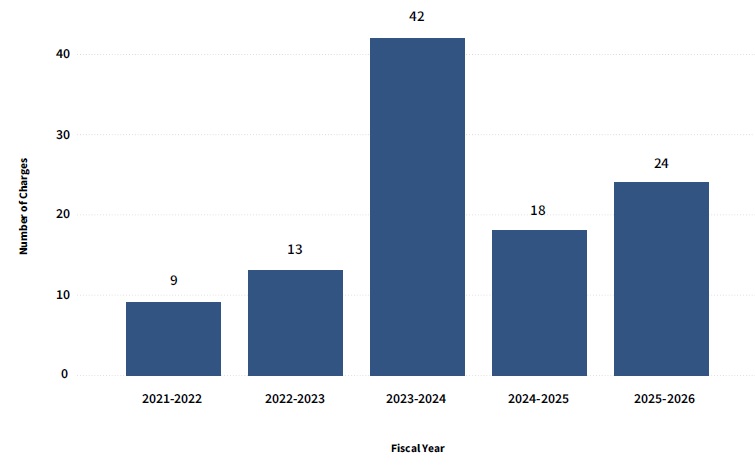
Text Version
| Fiscal Year | Number of Charges |
|---|---|
| 2021-2022 | 9 |
| 2022-2023 | 13 |
| 2023-2024 | 42 |
| 2024-2025 | 18 |
| 2025-2026 | 24 |
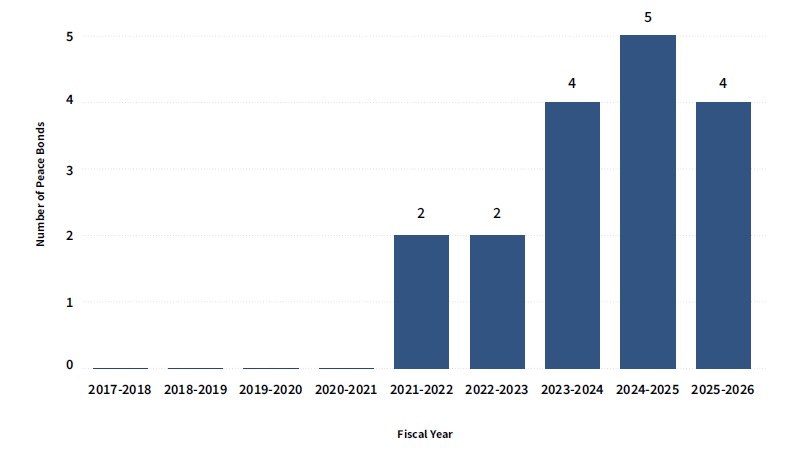
Text Version
| Fiscal Year | Number of Peace Bonds |
|---|---|
| 2017-2018 | - |
| 2018-2019 | - |
| 2019-2020 | - |
| 2020-2021 | - |
| 2021-2022 | 2 |
| 2022-2023 | 2 |
| 2023-2024 | 4 |
| 2024-2025 | 5 |
| 2025-2026 | 4 |
In R. v. Macdonald, the offender (20-21 years old at the time the offences were committed) was sentenced to 10 years in jail for multiple terrorism offences, including enhancing the ability of a terrorist group to facilitate a terrorist activity, facilitating terrorist activities, and committing indictable offences for the benefit of, at the direction of or in association with one or more terrorist group.
The offender participated in the creation, editing, and dissemination of three online recruitment videos on behalf of the Atomwaffen Division (AWD), a listed terrorist group. His conduct included producing and publishing violent and hateful imagery, as well as providing specialized equipment and technical expertise to support the group’s recruitment efforts.
He also produced and distributed images that willfully promoted hatred against an identifiable group, namely Jewish people, for the benefit of and in association with AWD.
Protecting Canada’s Environment, Economy and Borders
"Our responsibility is to ensure Canadians still trust the criminal justice system. We take into consideration what’s happening in the communities where we initiate prosecutions. It allows us to understand the consequences of decisions, and to understand what’s going on in the communities to keep them safe."
– Shannon O’Connor, Deputy Director of Public Prosecutions, Standing Committee on Fisheries and Oceans Committee Meeting, November 27, 2025
Protecting the Environment, Public Safety and Fair Markets
Federal prosecutors help protect the Canadian environment, including species at risk, migratory birds, and land and aquatic habitats. They also help protect vulnerable migrants and maintain the integrity of Canada’s borders in relation to both goods and people. In addition, prosecutors uphold the principle that everyone—individuals and corporations alike—must pay their taxes and must compete for contracts in a fair and honest manner.
Specialized Expertise in Complex Regulatory and Economic Cases
Dedicated regulatory and economic crimes prosecution teams across the country are responsible for prosecuting offences under more than 75 federal statutes and regulations. These are among the most complex offences handled by the PPSC, often raising cutting-edge legal issues.
High-Impact Prosecutions of National Interest
Regulatory prosecutions often attract substantial public interest. Recent examples include fisheries prosecutions related to the Atlantic elver and lobster fisheries, as well as human smuggling cases, including the prosecution of three individuals for transporting 44 migrants across the Canada-U.S. border.
Meaningful Sentencing to Deter and Denounce Serious Violations
PPSC prosecutors frequently seek significant fines or jail time to denounce, deter and punish serious violations of federal statutes. For example, in July 2025, an individual was sentenced to 6 years in jail and fined over $1 million for the illegal harvest and sale of sea cucumbers. The sentence reflected repeated and intentional breaches of the Fisheries Act and the resulting harm to marine habitats caused by overfishing.
Prosecutors also pursue targeted sentencing measures aimed at enhancing public health and safety, protecting Canada’s environment and borders, and discouraging financial wrongdoing.
Collaboration with Regulatory Enforcement Agencies
In addition to conducting prosecutions, we provide ongoing advice and support to regulatory enforcement agencies through training, bilateral meetings and policy development. Prosecutors routinely provide advice to our regulatory investigators at the investigation stage and receive support from them at the trial stage. This close and sustained collaboration strengthens both investigations and prosecutions.
Prosecutions in Canada’s North
"In Canada’s North, the delivery of justice must respond not only to the law, but to the realities of geography, language, culture, and lived experience."
– Alex Godfrey, Chief Federal Prosecutor, Northwest Territories Regional Office
Unique Legal, Geographic and Social Context
Fewer than 0.5% of the people living in Canada reside in the three territories, which together account for nearly 40% of the country’s land mass. Communities are spread across vast distances, and most are not connected by roads. Residents of the territories experience the highest rates of violent crime in Canada, particularly sexual offences and intimate partner violence. Indigenous women and girls are disproportionately affected by these crimes.
The three PPSC regional offices in the North (Yukon, Northwest Territories and Nunavut) are responsible for prosecuting both Criminal Code offences and all federal laws and statutes. This legal context, combined with geography and social realities, creates unique challenges and opportunities for the delivery of justice.
Delivering Justice in Remote and Linguistically Diverse Communities
Our prosecutors and Crown Witness Coordinators (CWCs) across the North regularly travel to and stay in remote communities to attend Court and provide prosecution services. Collectively, these communities speak more than 15 languages and dialects. Many have experienced systemic attempts to suppress their cultures, forced relocation, and intergenerational trauma resulting from acts of violence. Conducting prosecutions in this context requires specialized capabilities, cultural competence, and trauma-informed approaches.
Strengthening Victim Support
Funding allocated in response to the National Inquiry into the Missing and Murdered Indigenous Women, Girls and 2SLGBTQIA+ Peoples (MMIWG2S) is now a permanent part of our budget allocation. This funding will allow Northern offices to continue to address the Calls for Justice, build their capacity and better support victims through enhanced training, recruitment and retention of staff.
Crown Witness Coordinators: Bridging Cultural and Legal Systems
The CWC Program plays a critical role in bridging cultural and informational gaps between the court system and First Nations and Inuit victims and witnesses. CWCs explain the court process, clarify the roles of the justice system participants, and provide victims with information about their rights under the Canadian Victims Bill of Rights.
"There is nothing more raw than the grief of a mother who has lost a child to murder, the turmoil that comes with domestic violence and intimate partner violence, or the efforts made to make sense of the nonsensical actions of another. Walking alongside people during these times—often the most challenging of their lives—is an opportunity afforded to few. As such, it needs to be handled with sensitivity and deep compassion. As CWCs our hearts are often heavy, holding space for others pain, rage and resentment."
– Crown Witness Coordinator, Yukon Regional Office
CWCs work closely with our prosecutors and travel to communities during court circuits to support victims and witnesses. They provide court updates, accompany witnesses to proceedings, assist with trial preparation, and offer support during and after testimony. CWCs also act as liaisons between prosecutors, victims, and witnesses to ensure that their concerns are considered throughout the justice process. They further help identify support needs and connect individuals with appropriate territorial services. Well-informed and supported victims and witnesses are more likely to engage meaningfully in the court process.
In Nunavut, the CWC team also provide interpretation services for Inuktitut-speaking victims and witnesses. The Nunavut office is working to expand language-training opportunities to strengthen this capacity.
In recent years, the CWC role has expanded to include outreach to Indigenous communities and governments in support of Indigenous justice approaches and efforts to reduce Indigenous overrepresentation in the criminal justice system. This work is sustained through the permanent MMIWG2S funding.
In March 2026, the CWC team participated in a pan-Northern training exercise to share expertise and expand their knowledge to enhance their ability to provide trauma-informed support to victims and witnesses.
Specialized Responses to Sexual Violence is a Priority
Specialized Sexual Violence Prosecution Teams (SSVPT) have been established in the Northwest Territories and Nunavut, with a team currently being developed in Yukon. These teams are composed of dedicated, specially trained prosecutors, paralegals, and CWCs who work together to provide culturally competent, trauma-informed services to victims in an area of the law that is increasingly complex.
The teams aim to drive institutional change in how sexual violence cases—particularly those involving Indigenous women, girls and members of the 2SLGBTQIA+ community—are understood and addressed. Their work includes providing training and mentorship to prosecutors and police, improving consistency in victim support, and engaging with external stakeholders. Permanent funding tied to the Calls for Justice from the National Inquiry into Missing and Murdered Indigenous Women and Girls enables these teams to expand and strengthen their impact.
Addressing Intimate Partner Violence
Each territory has a high volume of cases involving intimate partner violence. In response, the Nunavut office is developing a dedicated internal team to focus on these cases, with the goal of enhancing expertise and consistency in prosecution.
The Yukon and Northwest Territories have dedicated prosecutors who work in two types of therapeutic courts. Wellness courts address the root causes of criminal behaviour prior to sentencing, including addictions, mental health issues, and Fetal Alcohol Spectrum Disorder. Additional courts offer alternative procedures for addressing intimate partner violence. These approaches encourage early accountability and provide supervised counseling and programming prior to sentencing.
In what Supreme Court of Canada Cases was the PPSC Involved?
Supreme Court of Canada Appeals and Interventions
During 2025–2026, we participated in several significant Supreme Court of Canada (SCC) cases addressing how the criminal justice system balances individual rights, public safety, transparency, and reconciliation. In keeping with the SCC’s role as a Court of direction, submissions made by our organization sought clear, principled guidance on trial delay, disclosure of police misconduct, seized property management, and the needs of Indigenous communities, reinforcing confidence in a fair, timely, and culturally informed justice system.
Right to be Tried Within a Reasonable Time
This year, there was a strong focus on the right to be tried within a reasonable time under section 11(b) of the Charter. These cases are significant because they will give clearer guidance on how courts should deal with delays in criminal cases. They will affect how prosecutors handle complicated cases—especially those with several accused—and what courts should do if cases take too long. Overall, the decisions will help ensure cases move forward in a fair and efficient way.
Although R. v. Jordan set general timelines for how long criminal proceedings should take, recent cases asked the SCC to clarify how those timelines would work in real situations. These decisions will shape how courts across Canada schedule trials, decide how complex a case is, and determine what to do when there are delays—helping maintain public confidence in the criminal justice system.
In His Majesty the King in Right of Canada v. Robert Vrbanic, et al., we asked the SCC to clarify how judges should decide if a case is "complex" when considering delays beyond the Jordan limits. We also asked the SCC to give trial judges discretion to allow cases to continue, even if they go past those limits, when it is in the interests of justice. The SCC allowed the Crown’s appeal from the bench, with written reasons to follow.
In His Majesty the King v. Elijah Jacques Taylor and R.B.-C. v. His Majesty the King, the SCC is looking at distinct aspects of delay in the criminal justice system. In Jacques Taylor, the SCC is considering how to assess delay in cases with multiple accused persons being tried together—specifically, whether delay caused by one accused should count against another. The DPP, as an intervener, argued that when a joint trial is appropriate, the extra time it takes should generally be considered reasonable.
In R.B.-C., the SCC is addressing whether the Jordan framework applies after a guilty verdict while waiting for sentencing. The DPP intervened to submit that delays after a verdict engages different interests and should not result in the imposition of another time limit and that a stay of proceedings will rarely be an acceptable remedy at that stage, but that other remedies—like reducing the sentence—may be more appropriate.
Public Confidence in the Administration of Justice
Several cases were related to rules that affect the public’s confidence in the criminal justice system. These cases highlight that public confidence not only depends on the outcomes of criminal cases, but also on the fairness, care, and transparency with which they are conducted.
In R. v. Fox, the SCC looked at a situation where police intercepted a phone call between a lawyer and her client during an authorized wiretap. The lawyer was charged with obstruction of justice after warning her client that police might search his home. An intercepted call between a lawyer and her client is considered privileged and its access is prohibited unless authorized by a judge. The SCC confirmed that a lawyer facing charges can ask to use privileged communications to prove their innocence but excluded the evidence against her because of serious mistakes in how the call was monitored by the police. The DPP intervened to explain that judges already have flexibility to set conditions to protect solicitor-client privilege during wiretaps. In the end, the SCC did not find fault with the wiretap conditions themselves, confirming that the current legal rules in this area remain sound.
In Chief of the Edmonton Police Service v. McKee, et al., the SCC will decide whether police misconduct records that have been statutorily removed by provincial disciplinary legislation must still be disclosed when they are relevant to a criminal case. This raised questions about how to balance an accused person’s right to a fair trial and full disclosure of the case against them with the statutory protections that allow police officers to have certain disciplinary findings removed from their record. In this case, we had a different perspective than the Edmonton Police Service. Relevant police misconduct records must be disclosed, even if they have been removed over time by provincial legislation. This wide-ranging decision will determine what kind of police misconduct records the Crown is expected to disclose in a criminal proceeding.
In His Majesty the King v. Thi Huyen Nguyen, et al., the SCC is considering what happens to property seized by police once a prosecution is stayed for unreasonable delay. The issue is whether a judge still has the authority to order the return or forfeiture of that property. The DPP intervened to submit that courts should continue to have jurisdiction, both under the Criminal Code and under the common law, to make sure that criminal property does not automatically return to an accused simply because a prosecution is halted. Decisions like this affect Canadians’ confidence that the justice system will deal responsibly with property connected to alleged offences and make sure that crime does not pay.
Reconciliation and Protection of Vulnerable Victims
In His Majesty the King v. Harry Arthur Cope, the SCC is examining how Gladue principles at the sentencing stage interact with Criminal Code provisions aimed at addressing intimate partner violence, particularly against Indigenous women. The SCC is considering how sentencing can account for Indigenous offenders’ circumstances while responding effectively to serious, recurring violence and protecting community safety. The SCC is also reflecting on the role of sentencing circles, which integrate Indigenous legal traditions and community perspectives, in our justice system and how the circle recommendations should be weighed by the sentencing judge in cases where denunciation and deterrence are central.
The DPP intervened to submit that Parliament intended to strongly denounce and deter intimate partner violence by the imposition of severe sanctions, including imprisonment. However, while this legislative intent was acknowledged, the DPP maintained that Gladue principles continue to apply. As the sole Crown intervener on sentencing circles, the DPP proposed that they can advance both restorative and traditional sentencing goals, and that judges should provide clear and reasoned explanations when departing from a circle’s recommendation.
This appeal engages core commitments to reconciliation, victim protection, and community safety, and the SCC’s guidance will assist sentencing courts in balancing these objectives.
How do we make sure new risks don’t undermine the quality or integrity of our prosecutions?
We work in a fast-changing environment shaped by evolving legal frameworks, public expectations, and rapid advances in technology. As an independent prosecuting authority, the organization must deliver fair, impartial and principled prosecution services—while adapting to challenges that could affect how we do our work.
External pressures are growing. Criminal activity is becoming more complex, technology is changing quickly, and justice processes are under greater public scrutiny. At the same time, we are facing a wider range of external threats. To keep pace, we need to stay flexible while protecting prosecutorial integrity and fairness.
Inside the organization, we are modernizing how we work. We are strengthening our governance, building stronger digital tools, and improving knowledge management. This helps reduce risks linked to older systems and supports secure, efficient operations. We are also focused on fostering a healthy and inclusive workplace—because a strong, engaged workforce is key to staying resilient. That includes supporting diverse hiring, developing talent, and planning for the future.
We take a proactive approach to managing risk. This means working closely with investigative agencies and partners, leveraging technology to improve case management and secure evidence disclosure, and strengthening internal controls to meet legal and policy requirements.
Looking ahead, we will continue to integrate risk considerations into our planning and decision-making through evidence-based approaches. By modernizing, strengthening partnerships, and promoting accountability, we aim to respond to new challenges while maintaining public confidence in the administration of justice.
How do we support the recovery of federal fines?
During fiscal year 2025–2026, the National Fine Recovery Program (NFRP) registered 2,161 accounts on recovery programs and collected 8,308 payments from 2,664 individuals. This resulted in the collection of $5.1 million dollars of fines that were previously unpaid. We were successful in reducing the overall inventory of unpaid fines by 4.1% compared to March 2025. The overall inventory of unpaid fines at the end of March 2026, contained 24,399 fines representing over $250 million.
In 2025–2026, the PPSC implemented a new NFRP directive to strengthen the recovery of federal fines across Canada. The directive establishes clear national standards to promote a more consistent, fair, and transparent approach to fine recovery.
It clarifies how recovery efforts should be prioritized based on the complexity and value of fines, restores the use of civil court action for high value or complex cases, and provides additional guidance to prosecutors on considering factors such as an individual’s ability to pay and realistic payment timelines at sentencing. Collectively, these measures are intended to improve compliance with fine orders and reinforce public confidence in the administration of justice.
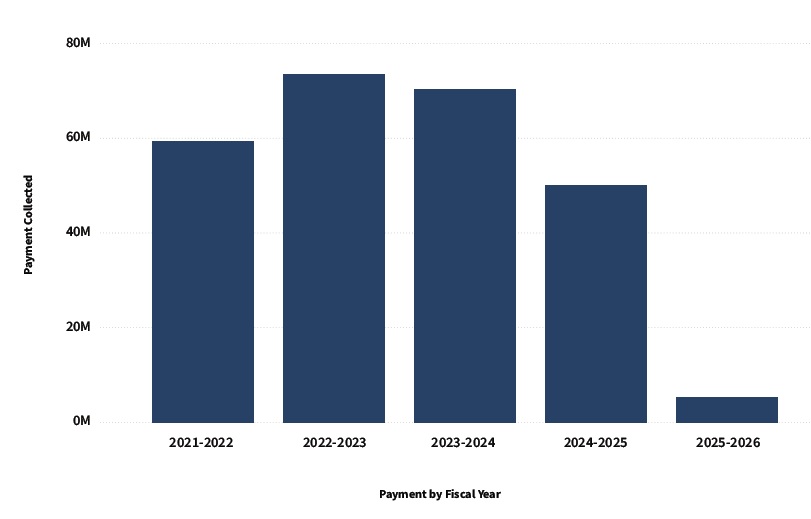
Text Version
| Payment by Fiscal Year | Payment Collected |
|---|---|
| 2021-2022 | $59,239,015.48 |
| 2022-2023 | $73,474,840.93 |
| 2023-2024 | $70,187,202.01 |
| 2024-2025 | $49,901,485.58 |
| 2025-2026 | $5,198,914.41 |
National Fine Recovery Program
Fine Recovery Process
If the accused is found guilty or pleads guilty, the prosecutor and the accused will propose a sentence, and the judge will decide the sentence and impose it. This may include issuing a fine to the accused who was found guilty as provided by law. The accused will be informed of the time period in which the fine must be paid. If they fail to do so, they are considered in default of paying that fine. It is at this point that the role of the National Fine Recovery Program (NFRP) begins.
Stage 1: Government Programs

NFRP collaborates with other government departments to help recover unpaid federal fines. For example, the Refund Set-off program administered by the Canada Revenue Agency, allows tax refunds and eligible credits payable to individuals to be applied against debts these individuals owe to the Crown. The NFRP also works with the Department of Fisheries and Oceans to manage fishing licenses for individuals who are in default of payment of a federal fine.
Stage 2: External Partners
The NFRP works with private organizations to help recover unpaid fines. Credit Bureaus give the NFRP valuable information regarding fine defaulters and private collection agencies reach out to these individuals to arrange payment.
Stage 3: Legal Procedures
On more complex and larger fines ordered against individuals and companies, the NFRP may undertake civil litigation under section 734.6 of the Criminal Code. This may include deducting money from wages and/or other income sources, seizure of bank accounts or other financial holdings, lien on properties, as well as the seizure and sale of property or assets to recover the value of unpaid fines. If these measures are unsuitable and the defaulter has no valid excuse for refusing to pay the fine, the defaulter may face jail time.
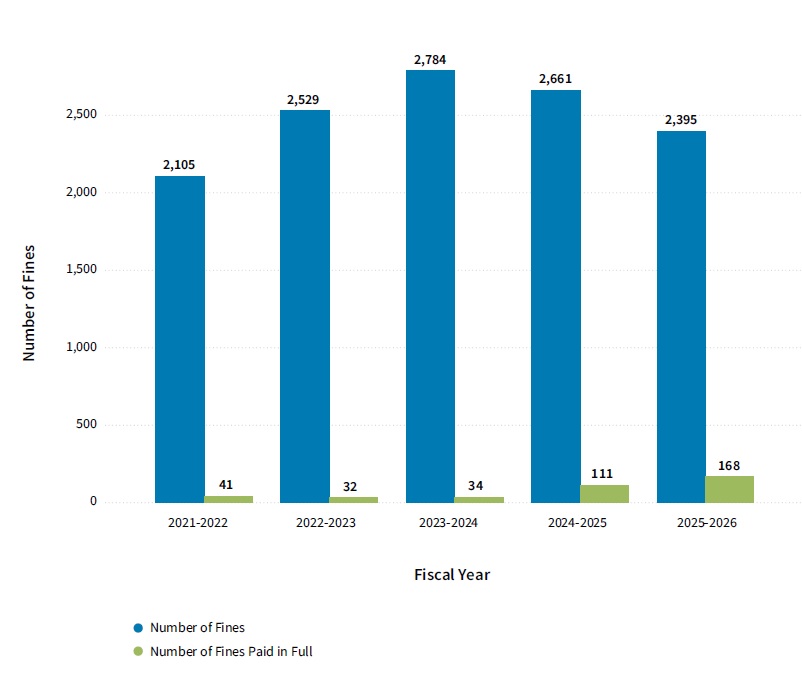
Text Version
| Fiscal Year | Number of Fines | Number of Fines Paid in Full |
|---|---|---|
| 2021-2022 | 2,105 | 41 |
| 2022-2023 | 2,529 | 32 |
| 2023-2024 | 2,784 | 34 |
| 2024-2025 | 2,661 | 111 |
| 2025-2026 | 2,395 | 168 |
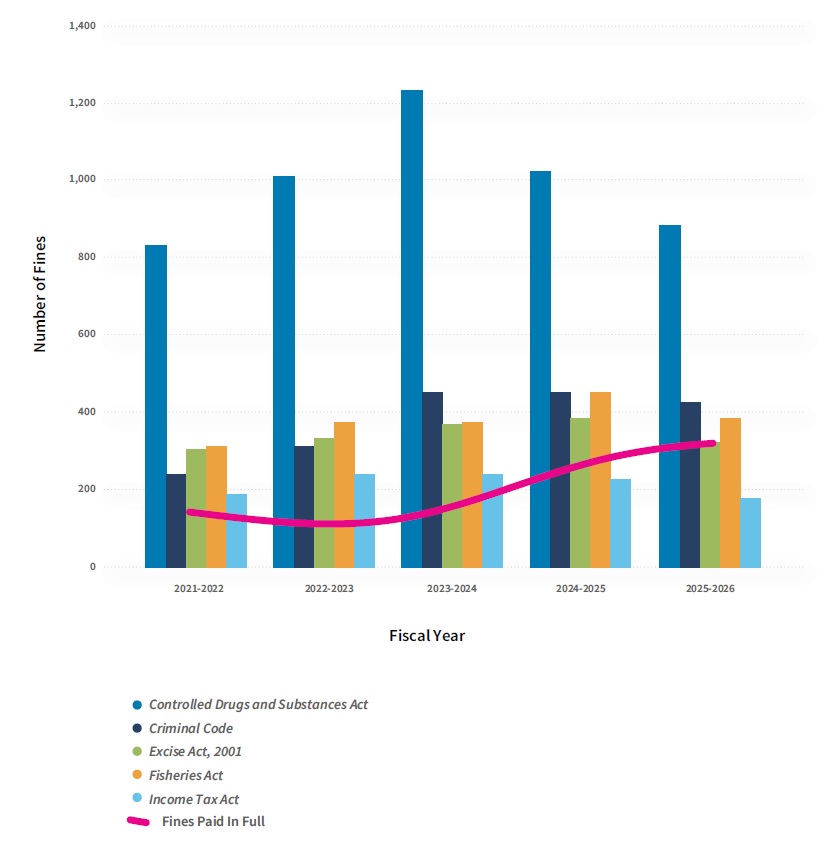
Text Version
| Fiscal Year | Controlled Drugs and Substance Act | Criminal Code | Excise Act,2001 | Fisheries Act | Income Tax Act | Fines Paid in Full |
|---|---|---|---|---|---|---|
| 2021-2022 | 822 | 239 | 303 | 309 | 189 | 42 |
| 2022-2023 | 996 | 309 | 331 | 373 | 239 | 32 |
| 2023-2024 | 1217 | 449 | 367 | 375 | 239 | 35 |
| 2024-2025 | 1010 | 444 | 376 | 447 | 218 | 87 |
| 2025-2026 | 871 | 419 | 320 | 378 | 181 | 90 |
Federal-Provincial-Territorial Heads of Prosecutions Committee
The Federal-Provincial-Territorial Heads of Prosecutions Committee brings together the leaders of Canada’s prosecution services, including those of the military prosecution service. Its goal is to promote mutual assistance and co-operation on operational issues and to ensure that consistent advice and litigation in criminal matters are provided by federal and provincial prosecution services. The DPP acts as standing co-chair and the PPSC provides coordination services to the Committee.
As a national body, the Committee has become a vital component of Canada’s prosecution landscape. The Heads of Prosecutions are regularly consulted on proposed amendments to the Criminal Code and by law enforcement agencies on broad, cross-jurisdictional issues. Recent Committee discussions have included best practices and strategies for:
- handling electronic evidence from body-worn cameras;
- appropriate exercise of prosecutorial discretion;
- addressing the overrepresentation in the criminal justice system of Indigenous, Black and racialized persons;
- communicating sensitive prosecution decisions involving witnesses, victims, and experts outside of Canada; and
- prioritizing the mental health and wellness of frontline prosecutors.
Case Profiles
Criminal proceedings begin with a police investigation into criminal activity. Prosecutors are responsible for assessing charges, either before charges are laid in charge review provinces (British Columbia, Quebec and New Brunswick), or after they have been laid directly by investigative agencies. At the charge assessment stage, our prosecutors review the evidence and apply the decision to prosecute test, by asking themselves:
- Does the admissible evidence demonstrate a reasonable prospect that a court would convict?
- If there is a reasonable prospect of conviction, is it in the public interest to prosecute?
If at any time in a prosecution, the charges do not meet both parts of the test, the prosecutor will end the prosecution. The role of public prosecutors in the Canadian federal criminal justice process is explained in further detail in this infographic.
Our prosecutors have the duty to be objective, independent, and dispassionate. Their role is not to seek conviction at any cost, but to put before the court all available, relevant, and admissible evidence necessary to enable the court to determine the guilt or innocence of an accused, who is presumed innocent until proven guilty beyond a reasonable doubt.
A verdict of guilty or not guilty is rendered at the end of a trial by a judge or in the case of a judge and jury trial, by the jury. A person charged with an offence can admit their guilt (plead guilty) at any stage in the criminal proceedings, before trial and during the trial, or before the verdict is rendered. Our prosecutors work competently and diligently in preparing cases for trial, including preparing for pre-trial applications. Pre-trial applications often involve questions about the law such as constitutional challenges and admissibility of evidence. The outcome can have extensive ramifications on the prosecution case and ultimately whether or not an accused person is found innocent or guilty at trial.
Case Profile
R. v. Althorpe
- Topic:
- Topic: National Security Terrorism Offence
- Summary:
- Facilitating terrorist activity
- Detailed Summary:
Matthew Althorpe pled guilty to producing and posting videos, images, publications, and messages inciting hatred against minority groups on a messaging platform. He created this material in association with, and for the benefit of, two terrorist groups.
He was sentenced to 20 years in jail for the several terrorism-related offences under the Criminal Code, including facilitating a terrorist activity (s. 83.19), instructing others to carry out a terrorist activity (s. 83.22), and committing an indictable offence—willfully promoting hatred—on behalf of a terrorist group (s. 83.2).
Case Profile
R. v. Nuridin Ali
- Topic:
- Controlled Drugs and Substances Act
- Summary:
- Largest cocaine seizure in Northwest Territories history
- Detailed Summary:
-
Nuridin Ali pled guilty to possession for the purpose of trafficking (s. 5(2) of the Controlled Drugs and Substances Act) and possession of property obtained by crime (s. 354(1) of the Criminal Code).
His guilty plea followed a lengthy police investigation. Officers executed a search warrant at a residence in Yellowknife where Mr. Ali was living. During the search, they seized 4.283 kilograms of cocaine and $385,695 in cash from various locations throughout the home. It is the largest drug seizure in Northwest Territories history.
At sentencing, Mr. Ali received 6 years in jail, and the seized proceeds were forfeited to the Crown.
Case Profile
R. v. Breton
- Topic:
- Proceeds of Crime
- Summary:
- Forfeiture of seized property after trial
- Detailed Summary:
-
In R. v. Breton, the PPSC obtained a landmark ruling from the Ontario Court of Appeal on the Crown’s ability to seek forfeiture of seized property after trial, even when the evidence is unlawfully obtained and the accused acquitted of all criminal charges.
Marcel Breton was charged with possession of proceeds of crime and several other offences. During the execution of a search warrant at his home, police found $1,235,620 hidden inside a container buried beneath the dirt floor of his garage. The trial judge later ruled that police lacked reasonable and probable grounds to search the garage, that the search was conducted unreasonably, and that the money should be excluded as evidence under s. 24(2) of the Charter. As a result, Mr. Breton was acquitted on all charges.
Despite the acquittal, the Crown applied under s. 490(9) Criminal Code for an order forfeiting the seized cash on the basis that Mr. Breton was not lawfully entitled to possession of it. After reviewing the extensive evidence presented at the forfeiture hearing, the trial judge ordered the $1,235,620 forfeited to His Majesty the King as proceeds of crime.
The Court of Appeal upheld the ruling. It found that:
- an acquittal does not necessarily preclude the Crown from seeking forfeiture of seized items at a subsequent forfeiture hearing;
- evidence excluded at trial may be admissible at a forfeiture hearing given that there are no criminal consequences or potential loss of liberty; and
- since Mr. Breton could not show that he was lawfully in possession of the seized property, and a lawful owner could not be located, the property should be forfeited.
Mr. Breton has since filed for leave to appeal to the Supreme Court of Canada. The PPSC has filed a response opposing the application for leave to appeal.
Case Profile
R. v. Steer
- Topic:
- Fisheries Act
- Summary:
- Illegal sea cucumber harvesting and sale operation
- Detailed Summary:
-
Scott Steer actively orchestrated an illegal sea cucumber operation of harvest and sale through a sham corporation that also involved his wife. He was convicted of illegal fishing, selling sea cucumbers caught in violation of the Fisheries Act, possessing and acquiring fishing vessels contrary to a prohibition order, and possessing fishing gear contrary to an order.
As the director of the sham corporation, Mr. Steer was sentenced to 6 years in jail. He, his wife and the corporation were fined more than $1,000,000 for offences under the Fisheries Act. The court also imposed additional orders, including a lifetime ban from fishing activities for Mr. Steer; forfeiture of vehicles, boat trailers, vessels, and electronic devices; and restitution to an underpaid crewmember.
The court considered significant aggravating factors: Mr. Steer’s lengthy criminal record and history of breaching court orders; the extensive planning and subterfuge involved; the abuse of trust; the substantial harm to marine resources, as overharvesting sea cucumbers threatens their ability to regenerate; and the protracted period over which the offences occurred. Mitigating factors were minimal. Mr. Steer showed no remorse and demonstrated active contempt for the court process, continuing his illegal activities even throughout the prosecution.
The evidence suggested that the couple had the means to pay the fines. Mr. Steer’s wife was held jointly and severally liable due to her active participation in the scheme. The sham corporation existed for the sole purpose of thwarting fisheries regulations. The investigation, prosecution and trial incurred enormous costs. There was no indication that the corporation had voluntarily paid any restitution or taken steps to prevent future offences.
Six years is a significant period of incarceration for an environmental offence, which the court found was not only proportionate and just, but necessary to protect the resource.
Awards and Achievements

Appointments
In 2025–2026, we were pleased to see five employees appointed as judges: Marina Elias (Ontario Court of Justice), Philippe Viau-Dupuis (Court of Quebec), Ghazala Shaheen Zaman (Ontario Court of Justice), Christa MacKinnon (Provincial Court of Nova Scotia), and Gordon Omar Akilie (Ontario Court of Justice).
Formal Awards
We are proud to highlight the achievements of our outstanding employees over the last year.
Achievement Award
The Achievement Award is one of the PPSC’s highest distinctions. It recognizes an individual or a team who, in performing their duties or executing a project, made an exceptional contribution in addressing the priorities of the PPSC. This past year this award was presented to several teams and one individual.
Members of the PPSC’s Access to Information and Privacy (ATIP) Office, Information Technology team, and Project Support and Oversight team demonstrated exceptional collaboration and innovation in delivering a transformative digital solution for the PPSC’s ATIP program. This project marks a significant milestone in modernizing the way PPSC works, aligning with the Government of Canada’s digital priorities.
The fourth team that was presented with this award was the Ontario region’s Agent Supervision Unit (ASU). Since January 2025, the ASU has performed at an extraordinarily high level during a period of significant operational, fiscal, and public pressure. Throughout this period, the ASU remained firmly focused on its core mandate: ensuring that meritorious prosecutions which were in the public interest could proceed.
In addition, Vivian Hansen was recognized for her career defined by leadership, compassion, and unwavering dedication to justice in the North. Vivian has been a passionate and steadfast advocate for the CWC Program, championing a simple but profound belief: that every victim of crime deserves to be heard, supported, and guided through a justice system that can often feel overwhelming. The CWC Program is stronger today because of Vivian’s contributions. She brought forward creative solutions, supported vulnerable people with dignity and care, helped preserve the integrity of many high-stakes prosecutions, and provided training and support across the North.
Prosecution Excellence Award
This award recognizes an individual prosecutor or a team of prosecutors who demonstrated a high level of commitment and dedication to the ideals of justice over a sustained period, and demonstrated excellence, professionalism, and ethical behaviour. This year this award was presented to the Steer trial team in the British Columbia region in acknowledgment of their exceptional work in the prosecution of offences under the Fisheries Act against Scott Steer and his company. The trial team consisted of: Joshua Cramer (counsel), Ian McFadgen (counsel), Katie Lohrasb (paralegal), Kellie Stewart (paralegal), Bernadette Fegarido (legal assistant), and Anna Le (legal assistant).
Over lengthy and complex proceedings, the Steer trial team consistently demonstrated an extraordinary level of professionalism, dedication, and mastery in their prosecutorial duties. At the sentencing hearing, Crown counsel showed their abilities as excellent and responsible advocates and demonstrated legal innovation. Given the offender’s unprecedented history, the Crown advanced its position on sentence as one of "first instance". The Crown ultimately secured a precedent-setting 6-year jail sentence, over $1.1 million dollars in monetary penalties, including fines and restitution orders against the offender and his company, as well as comprehensive lifetime prohibition orders.
Leadership Excellence Award
This award recognizes an employee who has demonstrated exceptional leadership and who has exerted a strong influence on a group, enabling them to achieve a common goal. This year’s award was presented to two individuals: Faith Chipawe and Rosellina Dattilo.
Faith Chipawe exemplifies what true leadership looks like within the PPSC. Her impact has been profound shaping our leadership landscape, strengthening our culture, and advancing equity and excellence across the organization.
Rosellina Dattilo has consistently demonstrated behaviours, decisions, and values that inspire trust, drive performance, and create positive organizational outcomes. Her ability to address issues head-on even in the most challenging circumstances and her capacity to find solutions while making people feel seen, understood and capable of their own abilities demonstrates true leadership.
Workplace Excellence Award
This award recognizes an individual or a team who have promoted and contributed to the improvement of a better workplace. This past year, the award was presented to the National Council for Black Employees: Faith Chipawe, Dami Awoniyi, Ayondele Akenroye, Celia Smith, Kathy Samuel, Jo-Ann Nanton, Andrea Grant, Paul Scotland, Bright Mugomeza, Iatasha Bachelor, Justice Nwabuwe, Le’Mar Davis, Hawa Barud, Olivier Boyard, and Gaëlla Kazanamahoro. This group of employees demonstrated exceptional strength and leadership, as well as strong commitment and results in highlighting and addressing systemic issues and the challenges and barriers faced by Black employees within the PPSC.
Administrative Professional Award
This award recognizes an individual or a team who has supported or contributed behind the scenes in ways that reflect well on the federal public service and the PPSC. Last year, this award was presented to Sabrina Théorêt-Jardon, Travel Manager for the Quebec Region. Regional travel coordination requires rigorous and diligent commitment, due to the numerous national compliance requirements and directives that must be followed, which often have to be adapted to fit the available budget and/or specific requests from our clients, judges, or any other important parties involved in the legal case in question. Ms. Théorêt-Jardon is proactive and constantly proposing options to improve internal processing flows. She also demonstrates leadership in her interactions with her peers.
Financial Information

Overview
During fiscal year 2025–2026, Parliament allocated a net vote operating budget of $240.7 million, including $237.2 million for regular operations and $3.5 million specific to the collection of outstanding federal fines. Furthermore, the PPSC recovered $19.2 million from other government departments, agencies and Crown corporations for prosecution activities related to their mandates. At year-end, there was a total net spending of $227.1 million and a total carryover of $13.6 million. From that carryover, an amount of $12.3 million resulting from the operating budget can be spent in the next fiscal year.
Information about funding and spending is summarized in the following graph (amounts in thousands of dollars):
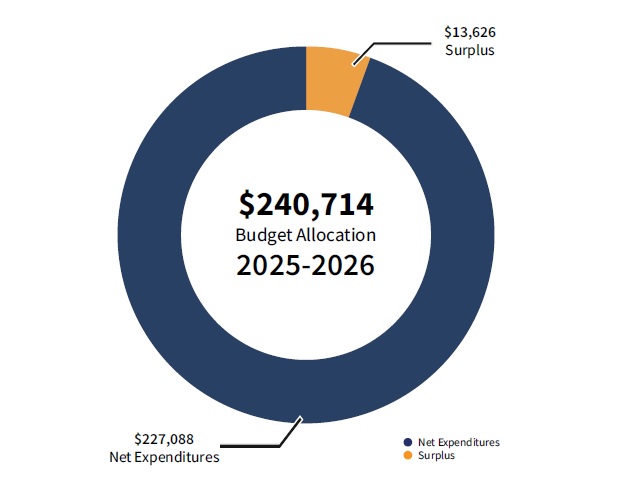
Text Version
| Budget | Amounts (thousands) |
|---|---|
| Budget Allocation | $240,714 |
| Net Exenditures | $227,088 |
| Surplus | $13,626 |
Prosecution Services
This core responsibility accounts for 83% of the PPSC’s total expenditures, mainly attributed to salaries and fees disbursed to Crown agents.
Internal Services
Administrative activities such as financial services, communications, human resources, information management, information technology, security, facilities, as well as health and safety support the core activities of our organization. These activities account for 17% of the total expenditures.
Contact Information

Public Enquiries
Public Prosecution Service of Canada160 Elgin Street, 12th Floor
Ottawa, Ontario K1A 0H8
1-877-505-7772
PPSC-SPPC.information@ppsc-sppc.gc.ca
Media Enquiries
Public Prosecution Service of Canada160 Elgin Street, 12th Floor
Ottawa, Ontario K1A 0H8
613-954-7803
Media@ppsc-sppc.gc.ca
Headquarters
Director of Public Prosecutions
Public Prosecution Service of Canada
160 Elgin Street, 12th Floor
Ottawa, Ontario K1A 0H8
Deputy Director of Public Prosecutions
Public Prosecution Service of Canada
160 Elgin Street, 12th Floor
Ottawa, Ontario K1A 0H8
Deputy Director of Public Prosecutions
Public Prosecution Service of Canada
160 Elgin Street, 12th Floor
Ottawa, Ontario K1A 0H8
Senior Director General
Corporate Services Branch
Public Prosecution Service of Canada
160 Elgin Street, 12th Floor
Ottawa, Ontario K1A 0H8
Regional Offices
Alberta
Elizabeth O’Grady
Chief Federal Prosecutor
Public Prosecution Service of Canada
Epcor Tower
10423 – 101 Street N.W., suite 700
Edmonton, Alberta T5H 0E7
780-495-3553 Alberta Region – Calgary
700 6th Avenue S.W., suite 900
Calgary, Alberta T2P 0T8
403-299-3978
Atlantic
Shaun O’Leary
Chief Federal Prosecutor
Public Prosecution Service of Canada
Duke Tower
5251 Duke Street, Suite 1400
Halifax, Nova Scotia B3J 1P3
902-426-5535 Atlantic Region - Moncton
777 Main Street, Suite 400
Moncton, New Brunswick E1C 1E9
506-851-4391 Atlantic Region - St. John’s
Atlantic Place
215 Water Street, Suite 812
St. John’s, Newfoundland and Labrador A1C 6C9
709-772-8046
British Columbia
Todd Gerhart
Chief Federal Prosecutor
Public Prosecution Service of Canada
800 Burrard Street, 12th floor
Vancouver, British Columbia V6Z 2G7
604-666-5250 British Columbia Region – Surrey
15300 54A Avenue, Unit 200
Surrey, British Columbia V3S 6T4
236-456-0020
Manitoba
Michael Foote
Chief Federal Prosecutor
Public Prosecution Service of Canada
234 Donald Street, Suite 515
Winnipeg, Manitoba R3C 1M8
204-983-5738 Manitoba Region – Kenora
308 Second Street S., Unit 210
P.O. Box 207
Kenora, Ontario P9N 1G4
807-470-0029
National Capital
Andrea Levans
Acting Chief Federal Prosecutor
Public Prosecution Service of Canada
160 Elgin Street, 14th Floor
Ottawa, Ontario K1A 0H8
613-957-7000 National Capital Region – Thunder Bay
221 Archibald Street North
Thunder Bay, Ontario P7C 3Y3
807-623-2255
Northwest Territories
Alex Godfrey
Chief Federal Prosecutor
Public Prosecution Service of Canada
Greenstone Building
5101 50th Avenue, 4th Floor
P.O. Box 8
Yellowknife, Northwest Territories X1A 2N1
867-669-6900
Nunavut
Stephanie Boydell
Chief Federal Prosecutor
Public Prosecution Service of Canada
933 Mivvik Street, 2nd Floor
P.O. Box 1030
Iqaluit, Nunavut X0A 0H0
867-975-4600
Ontario
Tanit Gilliam
Chief Federal Prosecutor
Public Prosecution Service of Canada
130 King Street W., Suite 2400
P.O. Box 340
Toronto, Ontario M5X 2A2
416-952-0812 Ontario Region – Brampton
7685 Hurontario Street, 4th floor
Brampton, Ontario L6W 4P5
905-454-2424 Ontario Region – Kitchener
29 Duke Street E., 15th floor, Suite 202
Kitchener, Ontario N2H 1A0
519-585-2970 Ontario Region – London
465 Richmond Street, Unit 201
London, Ontario N6A 5P4
519-645-2650
Quebec
Isabeau Morrissette
Chief Federal Prosecutor
Public Prosecution Service of Canada
Guy-Favreau Complex, East Tower
200, René-Lévesque Boulevard W., 9th Floor
Montréal, Quebec H2Z 1X4
514-283-2935 Quebec Region – Québec
925, 9e rue de l’Aéroport
Québec, Quebec G2G 2S5
418-648-3131
Saskatchewan
Crystal Warde
Chief Federal Prosecutor
Public Prosecution Service of Canada
123 Second Avenue S., Suite 801
Saskatoon, Saskatchewan S7K 7E6
306-975-5477 Saskatchewan Region – Regina
Hill Tower 3
2010 12th Avenue, 5th floor
Regina, Saskatchewan S4P 0M3
306-780-8834
Yukon
Surinder Aujla
Acting Chief Federal Prosecutor
Public Prosecution Service of Canada
Elijah Smith Building
300 Main Street, Suite 200
Whitehorse, Yukon Y1A 2B5
867-667-8100
- Date modified: